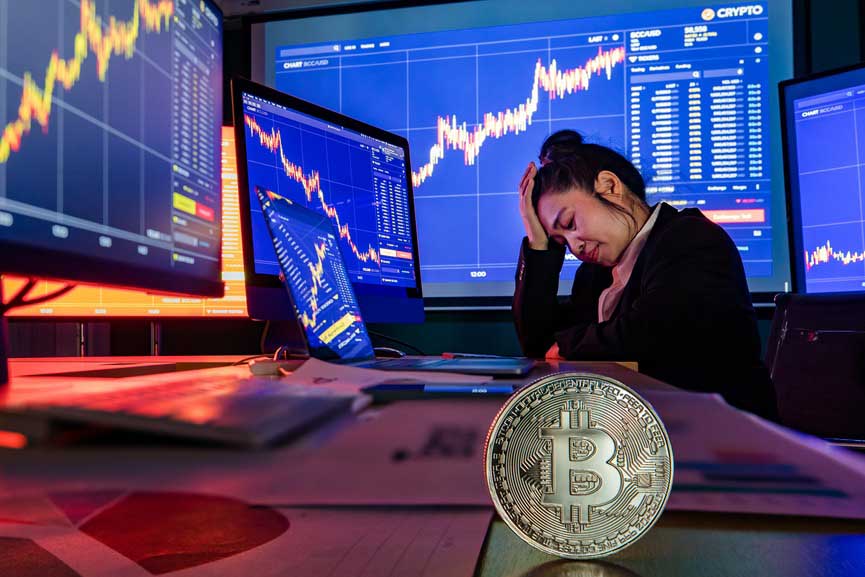
After reaching its 2025 peak, Bitcoin has lost more than half its value, making this essential reading for investors and prospective buyers who view the sharp decline as a potential buying opportunity.
Bitcoin fell below the closely watched $60,000 level in late June, extending a slide from its record above $126,000 in October 2025. The fall has revived a familiar debate around the world’s largest cryptocurrency.
There is no simple answer. Bitcoin’s weakness reflects tighter financial conditions, a stronger US dollar, withdrawals from spot Bitcoin funds, weaker demand for speculative assets, and forced selling within the crypto market.
This is severe, but not unprecedented. Historical market data show that Bitcoin has suffered several declines of more than 50 percent since 2014, while its three deepest previous peak-to-trough falls averaged close to 80 percent.
Bitcoin later recovered from earlier crashes and reached new records. That history may support long-term optimism, but it does not guarantee another recovery or show how long one might take.
Unlike a company, Bitcoin does not generate earnings, dividends, or rent. Its market value depends mainly on demand, liquidity, scarcity, regulation, and investor confidence. Traditional valuation methods, therefore, cannot establish a clear, fair price.
Why is it more worrying this time?
The percentage fall is smaller than some earlier crashes, but Bitcoin is now more closely connected to the wider financial system.
Greater institutional exposure: Bitcoin is no longer driven mainly by individual traders. Spot exchange-traded products, publicly listed companies, and large investment funds now hold significant exposure. Research published by the International Monetary Fund found that crypto became more closely correlated with equity markets as institutional participation increased.
ETF outflows: Spot Bitcoin funds brought a major new source of demand into the market. When investors redeem their holdings, that support weakens, and fund managers may need to reduce Bitcoin exposure. Recent outflows do not prove institutions have permanently rejected the asset, but they add pressure when confidence is already fragile.
High rates and a strong dollar: The Federal Reserve kept its target rate at 3.50 to 3.75 percent on June 17 and said inflation remained above its 2 percent goal. Higher rates make government securities and deposits more attractive, while Bitcoin pays no interest. A strong dollar can also draw capital away from risky assets.
Corporate exposure: Companies holding large Bitcoin reserves face declining asset values and greater balance-sheet risk when prices fall. This does not automatically mean they are in financial distress, but the consequences now extend beyond individual crypto traders.
Leveraged liquidations: Leverage allows traders to control positions larger than the money they deposit. When prices fall beyond set levels, exchanges close those positions automatically. The Bank for International Settlements has noted that leveraged unwinds can intensify market moves. Like falling dominoes, forced sales can push prices lower and trigger further liquidations.
Bitcoin is often described as “digital gold” and promoted as protection against war, political instability, and weak national currencies. In practice, it does not consistently behave like gold.
During a crisis in one country, Bitcoin may help people facing capital controls, banking restrictions, or a collapsing local currency. It can move value without depending entirely on domestic banks.
A global conflict creates a different response. Large investors often reduce risk and move towards cash, the US dollar, government bonds, or established safe-haven assets. Bitcoin can be sold alongside equities because it remains highly volatile and can be converted into cash at any time.
War can also increase oil, transport, and insurance costs. That can push inflation higher and make central banks less willing to cut interest rates. The result may be additional pressure on Bitcoin even as geopolitical uncertainty rises.
The distinction is important. Bitcoin may be useful to individuals trying to move money during a local financial crisis, yet it still falls in global markets as professional investors reduce risk.
Other pressures on the market
Artificial intelligence has become a competitor for speculative capital. Semiconductor businesses, data centers, and major technology companies are attracting investment as AI infrastructure expands.
There is no authoritative evidence that every dollar leaving Bitcoin is moving directly into AI. Investors may also be shifting towards bonds, cash, gold, or other assets. The safer conclusion is that Bitcoin now competes with a wider range of high-growth opportunities.
Clearer regulation may improve consumer protection and institutional confidence. It cannot guarantee higher prices or remove the risk of loss.
Network activity can also be misunderstood. A high volume of blockchain transactions shows the network is in use, but it does not prove that long-term investors are buying more Bitcoin.
Counting transactions is like counting vehicles on a busy road. Heavy traffic confirms activity, but it does not reveal where the drivers are going or how valuable their vehicles are. One exchange, automated service, or individual can generate many transactions. Network activity may indicate technical use, but it cannot predict price direction on its own.
Rep. Image | Credits: pvproductions @ Magnific
Is Bitcoin now cheap?
The reality is that there is no objective answer. A sharp fall from an earlier price may look attractive, but the old price does not prove that the new one is a bargain. A product marked down by half is only a good value if it is still worth the reduced price.
Bitcoin could recover if fund demand returns, interest rates fall, or investor confidence improves. It could also decline further if liquidity tightens, redemptions continue, or forced selling increases.
Anyone claiming to know the exact market bottom should be treated with caution. The more useful question is not whether Bitcoin looks cheaper than it did in October, but whether the buyer can withstand another substantial fall.
What buyers should examine
Before buying Bitcoin, investors should consider the following:
Ability to absorb losses: Bitcoin could fall much further. Money needed for housing, healthcare, education, debt payments, or emergencies should not be exposed.
Position size: A limited allocation within a diversified portfolio is different from placing most personal savings in one volatile asset.
Debt and leverage: Borrowing to invest creates two risks. The asset may fall while the loan and interest still have to be repaid. Leveraged positions may also be closed automatically.
Investment purpose: Buyers should decide whether they seek long-term exposure, short-term trading, or diversification. Without a clear purpose, decisions are more likely to be driven by fear or excitement.
Exit plan: Investors should decide in advance what would cause them to reduce or sell their holdings. Panic is not a strategy.
Tax and reporting obligations: Rules differ across jurisdictions. Investors should retain records of purchases, sales, transfers, and fees, and seek professional advice where necessary.
A Bank for International Settlements study covering crypto exchange use in 95 countries estimated that 73 to 81 percent of retail investors in its dataset probably lost money on their initial Bitcoin investments. It also found that participation increased after prices had already risen, a reminder that popularity often attracts buyers near market peaks.
A license does not guarantee profits or prevent business failure. It provides regulatory oversight and a clearer legal framework than an offshore platform does.
Custody also matters. Keeping Bitcoin on an exchange creates exposure to hacking, suspended withdrawals, and company failure. Moving it to a private wallet reduces some exchange risk but transfers full responsibility to the owner.
The US Securities and Exchange Commission’s investor guidance advises retail investors to understand how crypto assets are held and what happens if a custodian fails. Losing a private key or recovery phrase can result in permanent access loss.
Investors should use unique passwords, app-based two-factor authentication, and, where available, withdrawal controls. Recovery phrases should never be shared, photographed, or stored in email or messaging applications.
Promises of guaranteed returns, pressure to act immediately, and requests to transfer crypto for ‘verification’ are common warning signs of fraud.
The real test for buyers
Bitcoin remains a scarce, globally traded, and technologically significant digital asset. It is also highly volatile, difficult to value, and sensitive to liquidity, monetary policy, regulation, and investor sentiment.
However, the current decline does not prove that Bitcoin has failed, nor is it reasonable to judge it that way. Does its active network prove that the price will recover? As with any digital asset, the honest answer is uncertain.
For potential buyers, the most important question is not whether Bitcoin will rise again. It is whether they truly understand the risks, whether they can withstand a much deeper fall, and whether they are investing only money they can afford to lose. Remember, that is the real question.
Editorial Disclaimer:This article is for general information only and does not constitute financial, investment, legal or tax advice. Cryptocurrency investments are highly volatile and may result in substantial or total loss. Readers should seek independent professional advice before investing.