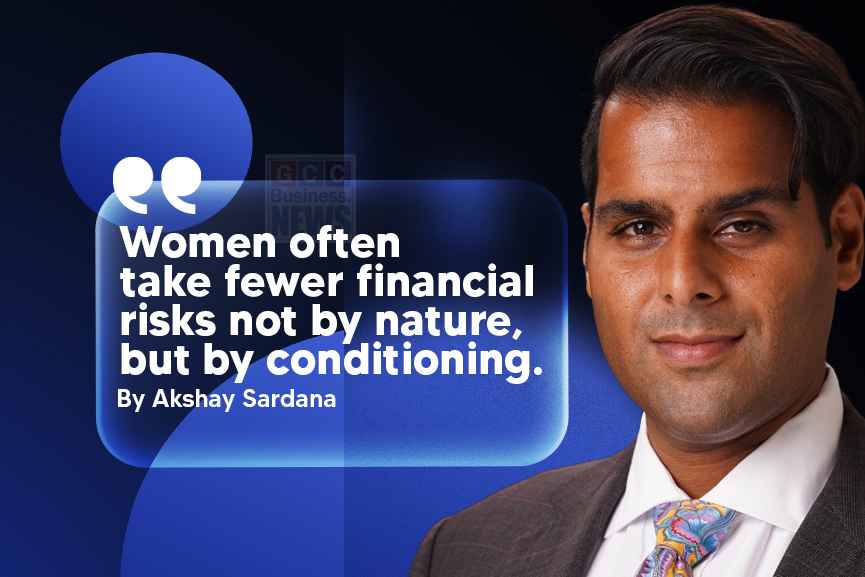
Reshma Saujani, founder of Girls Who Code, once made an observation so precise it has stayed with me ever since: “We raise our boys to be brave and our girls to be perfect.” She was talking about coding. But she was also, without meaning to, describing exactly what happens when girls encounter money.
For girls, early exposure to finances can have a lasting effect. When they are invited into these conversations from a young age, they grow up seeing money not as an intimidating adult subject but as a practical part of life they are fully capable of understanding. That shift matters. It shapes how they ask questions, how they make decisions, how they negotiate, and how comfortably they see themselves taking charge of their future.
We do not raise confident investors at 30. We raise them at the dinner table at 10. If we want women to take seats in boardrooms, they must first take seats at financial conversations at home.
The good news is that this is addressed through something simple: visibility. Let her sit at the table when financial decisions are discussed. Explain why one option was chosen over another. Walk her through how a major purchase was budgeted for. Show her what trade-offs look like in real time.
All it takes is providing the same financial exposure we extend to boys, offered without hesitation and without the assumption that they will find it less interesting.
Hone the existing instincts
Girls develop the raw materials of financial thinking early. A nine-year-old who spends forty minutes deciding whether to trade a Pokémon card – consulting peers, cross-referencing what others paid, walking away when the offer does not feel right – is already doing due diligence.
Image supplied by Continental Group | Edited and designed by Team GBN
A teenager who tracks prices across three sites before committing, or negotiates her way to a better deal on something she actually wants, is practising the same discipline that institutional investors spend careers trying to systematise. Yet, it is common to see teenage girls negotiate fiercely over something they care about, but hesitate the moment the subject turns to investing.
The key is to name it. When she negotiates well, say so. When she waits rather than overpays, point out the discipline. When she changes her mind after gathering new information, reinforce that flexibility is strength, not indecision. The gap is often not in the instincts, but in whether anyone connects those instincts to finance.
That connection can be made in everyday ways. Let her compare two service providers and explain her reasoning. Ask which subscription she would cancel if costs needed trimming. Show her how to evaluate value, not just price. Confidence often grows this way, through participation before instruction, through familiarity before jargon.
Encourage educated risks
A lot of studies suggest[1] that women take fewer financial risks. Women are not risk-averse by nature. They are, in many cases, risk-aware in ways that markets reward over long time horizons. The shortcoming is in limited exposure to the mechanics of risk itself.
Risk becomes less intimidating when it is observed. If possible, let her track a small investment over time. Show her what happens when markets dip – and what happens when they recover. Explain why long-term investors do not react to every fluctuation. If she earns money from part-time work or gifts, consider allocating a small portion toward something that can grow, even modestly, and review it together periodically.
A young girl who watches money behave over time, who sees an investment dip and recover, who is present when a financial decision is made and is asked what she thinks, begins to build a working relationship with uncertainty. She learns that uncertainty is not a reason to retreat. It is something that can be understood, navigated and managed. That understanding prepares someone to act when action is needed, rather than waiting to feel perfectly ready.
What the next generation needs
This is not just a household issue. Women are set to control[2] a growing share of global wealth over the next two decades. Yet many enter adulthood having observed money decisions rather than shaped them. Early exposure is not symbolic. It is economically consequential.
Representational image source: Magnific | Cropped by Team GBN
Women who develop financial confidence early demonstrate measurably different outcomes. They display higher rates of entrepreneurship, stronger salary negotiation, and more consistent long-term investment behaviour. Confidence does not follow financial knowledge. It develops alongside it, through accumulated experience of making decisions, being wrong occasionally, and continuing anyway.
That experience has to start somewhere, and it cannot start at 25. Adolescence remains a powerful phase for exactly this kind of formation, but it does require intention. Talk openly about why one option offers better value than another. Let her help plan a holiday budget. Show her how saving works when there is a longer goal involved. If there is a family business, explain the difference between salary and profit. If there are investments, explain what compounding means in practice, not just in theory.
In finance, perfectionism can sometimes be less rewarding. It can keep people out of markets, out of negotiations, and out of the decisions that compound over decades. Courage, by contrast, tends to pay its own dividends.
This Women’s Day, the most useful shift we can make is relatively easy.. Invite girls into real conversations about money. Give them a voice in decisions that affect them. Let them earn, track, question and evaluate. Financial excellence is rarely built in one lesson. It is built through repetition, participation and example.
About Akshay Sardana
The Chief Executive Officer at the Continental Group, a leading financial services provider and insurance intermediary he joined in 2009, Akshay Sardana embodies the organization’s aspirations for the future. A graduate of the Boston University School of Management, Akshay honed his skills at Citigroup, New York, where he held strategic roles on the derivatives and fixed income desks. On his return to the Middle East, where he spent his formative years, Akshay brought a renewed, international perspective, which he has since ingrained in the Continental Group’s expansion and business development.
Image supplied by Continental Group | Edited and designed by Team GBN
As an integral member of the company, Akshay is currently spearheading its expansion into Asia, Africa, and Europe while fostering existing global relationships with banking partners, financial institutions, and insurance carriers — all without letting his passion for adventure travel and jazz piano go untended.
About Continental Group
The Continental Group is a leading insurance intermediary and financial services solutions provider in the GCC region. Licensed by the Central Bank of UAE, the Securities and Commodities Authority (SCA) of the UAE, and DFSA (CFS DIFC Limited from The Continental Group is regulated by the DFSA), the group represents reputed multinational and local insurance and financial institutions.
Founded in 1994, Continental is the brainchild of Ashok Sardana, who built the company on three pillars: Integrity, insight and innovation. Continental’s unparalleled industry experience, embodied by a team of over 250 highly-qualified professionals, has enabled its expansion across Europe, Middle East and Asia. Its stellar track record of fostering life-time, meaningful relationships with customers is rooted in its ability to provide tailor-made, personalized solutions.
It is a household name for all financial and insurance solutions at any stage of one’s life: Investments, savings, wealth creation, legacy, succession and protection planning, life, health, employee benefits, auto, home, and travel. The Continental Group has also been actively advocating for financial freedom & independence, financial inclusion, ESG investing, and wellbeing, through its popular podcast “Dollars and Dirhams”.