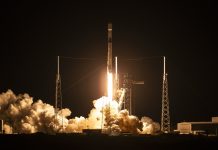
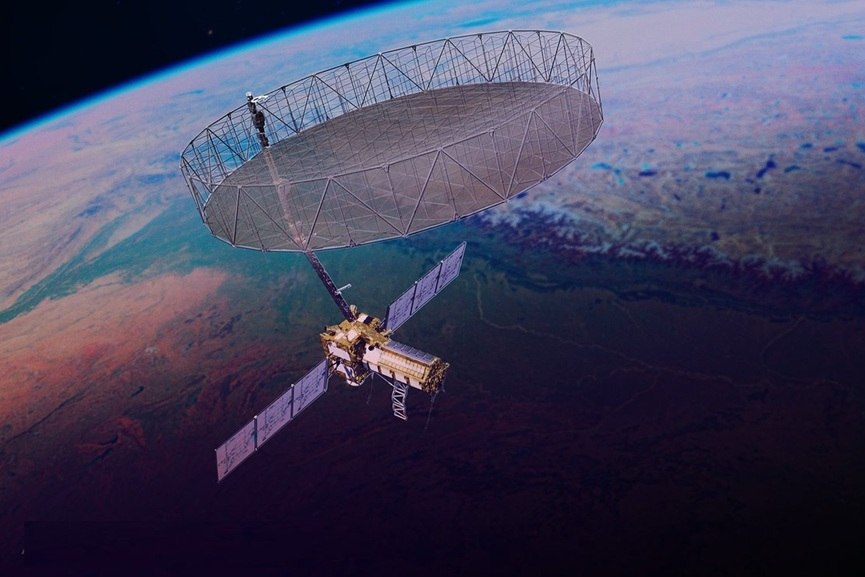
NASA and ISRO’s joint satellite mission, NISAR, has achieved a major milestone with the successful deployment of its 12-meter radar antenna reflector in low Earth orbit, just 17 days after its launch from India’s southeastern coast.
The satellite, launched on July 30 from the Satish Dhawan Space Centre by the Indian Space Research Organisation (ISRO), now features a fully deployed 39-foot-wide antenna reflector, a critical component of the mission’s advanced synthetic aperture radar (SAR) systems. The deployment was confirmed on August 15 after a precise sequence of unfolding and locking mechanisms.
NISAR (NASA-ISRO Synthetic Aperture Radar) is designed to monitor Earth’s dynamic surface processes with unmatched precision. It will track ice sheet movements, land deformation from natural disasters, and changes in forests and wetlands. The mission supports applications in disaster management, infrastructure monitoring, and agriculture, contributing directly to climate science and environmental decision-making.
What sets NISAR apart is its use of dual-frequency radar technology. It combines NASA’s L-band SAR, capable of penetrating clouds and vegetation, with ISRO’s S-band SAR, sensitive to surface moisture and light vegetation. The shared reflector, essential for both systems, simulates a massive radar antenna, equivalent to 12 miles in length, using SAR processing to deliver high-resolution data with pixel sizes as small as 10 meters.
The reflector’s deployment involved a precise mechanical process. Weighing 64 kilograms, the drum-shaped assembly consists of 123 composite struts and a gold-plated wire mesh. On August 9, a 9-meter boom unfolded gradually from the spacecraft. Then, explosive bolts released the reflector on August 15, allowing it to ‘bloom’ into its full shape using stored tension and motor-driven cables.
NISAR builds on decades of radar development, from Seasat (1978) to Magellan (1990s). It is also a testament to deepening U.S.-India space cooperation. ISRO contributed the S-band radar and spacecraft bus, while NASA/JPL provided the L-band radar, antenna boom, and data subsystems.
Launch operations and antenna deployment are being monitored by ISRO’s global telemetry and tracking network. With full deployment complete, NISAR is now poised to begin its mission of transforming how scientists and policymakers observe Earth’s vital processes.
Also Read | NASA’s SpaceX Crew-10 returns safely after ISS mission