GenZone began with a problem its founders experienced firsthand: managing UAE- and US-based companies through disconnected advisers, portals, and compliance calendars. Its answer is a unified dashboard backed by human expertise.
For years, company formation followed a familiar process. A founder submitted documents to a consultant, waited for updates by email or phone, and received a licence or incorporation certificate when the process was complete.
That approach can still register a company. It is less effective at helping a founder understand what is happening across the full life of the business.
Founders increasingly manage payroll, accounting, banking and analytics through digital platforms. They can see what has been completed, what is delayed and what requires action. Company formation is moving towards the same level of visibility.
Dubai’s government is already moving in this direction. In June 2026, Dubai’s Department of Economy and Tourism (DET) launched SME in a Box, providing a single-entry point to licensing support, banking, payments, logistics, telecommunications and other services.
The initiative launched with 18 private-sector partners. DET estimates that participating offers could provide more than AED 80,000 in potential value per business, depending on the services selected. It also estimates that founders using its banking and payment solutions could save up to 200 hours otherwise spent comparing providers and completing separate onboarding processes.
Those figures are DET estimates rather than guarantees. Even so, the initiative confirms a larger change: founders and public institutions now view fragmented onboarding as a problem that technology should reduce.
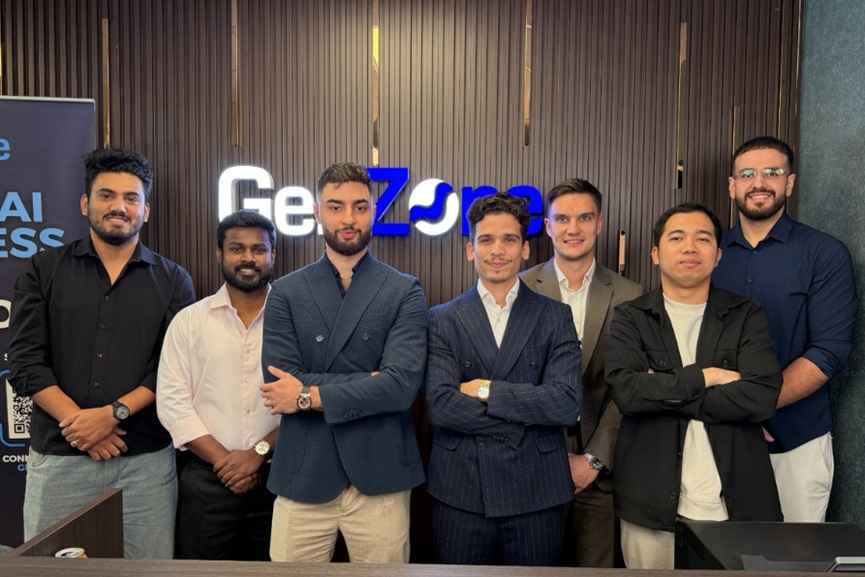
Image Source: GenZone | The GenZone team receives an award for excellence at a ceremony.
The cross-border gap
The challenge becomes more complicated when a founder operates across jurisdictions. A business may use a UAE company for regional operations while maintaining a Delaware or Wyoming LLC for a separate US-facing activity. Whether such a structure is appropriate depends on the founder’s business, legal and tax circumstances.
A US entity may require an Employer Identification Number from the Internal Revenue Service. Delaware LLCs must pay a USD 300 annual state tax by June 1, while Wyoming entitiesgenerally file annual reports according to their anniversary month.
The founder may therefore be managing:
Two formation processes
Separate document sets
Different renewal and filing dates
Banking and payment relationships
UAE licensing, tax and residency requirements
Questions that cross more than one legal system
None of these tasks is necessarily difficult in isolation. The difficulty comes from having no single view of them.
GenZone grew from experience
According to GenZone, the company was founded by two globally mobile entrepreneurs after they relocated from Canada to Dubai. Their move was influenced partly by the UAE’s international business and tax environment, but their experience revealed that relocation and company formation were not single transactions.
They had to coordinate company setup, documents, banking, residency-related processes and US business requirements through separate channels. Updates were scattered across emails, messages and provider portals. No one system presented the complete picture.
GenZone built its platform around that first-hand experience. Its model is not simply to submit formation applications. It gives internationally mobile founders one place to view UAE and US setup progress, important documents, recurring obligations and the next actions required.
The platform combines:
A shared view of UAE and US company processes
Status tracking for applications and documents
Alerts for renewals and compliance dates
Organised access to business records
Human guidance when judgement is required
That last element matters. A dashboard can display a deadline, but it cannot independently decide whether a structure is suitable, interpret every tax consequence or secure a banking relationship.
Image Source: GenZone | GenZone’s Leadership and Management Team
Formation is only the start
Registration creates the legal entity. It does not complete the founder’s responsibilities.
In the UAE, persons subject to corporate tax must register with the Federal Tax Authority and obtain a corporate tax registration number. In Delaware and Wyoming, annual state obligations continue even after the company has been formed.
This is why the most useful formation platforms are likely to extend beyond incorporation. Their value will come from helping founders maintain visibility over filings, renewals, licences, documents and professional support throughout the company’s life.
A missed date can lead to penalties, loss of good standing or disruption to operations. A reliable dashboard does not remove the obligation. It makes the obligation harder to overlook.
Software still needs expertise
Company formation is not becoming purely self-service. Cross-border structuring, tax residence, licensing choices and banking still require informed human judgement.
The stronger model combines both sides: software for visibility and organisation, and experienced advisers for decisions that cannot be reduced to a status bar.
GenZone’s strength comes from having built that combination around a problem its founders personally faced. By turning fragmented UAE and US company management into one clear operating view, it represents more than a faster formation service. It shows what company setup is becoming: an ongoing system, not a waiting game.