As artificial intelligence places growing pressure on established digital hubs, the next geography of compute may be built across a wider Eurasian map.
For more than a decade, Singapore has provided a powerful blueprint for how strategic planning can transform a compact country into a global digital centre.
Its position was built through political stability, regulatory certainty, international connectivity, sophisticated infrastructure and a favourable business environment. For companies operating across the Asia-Pacific, Singapore evolved from a preferred location into a default digital gateway.
The AI era, however, is changing the economics of digital infrastructure.
AI is changing the geography of computing
Connectivity, legal frameworks and proximity to customers remain essential. But advanced AI workloads require far more electricity, cooling and physical space than traditional digital services.
The next generation of infrastructure increasingly depends on:
Immediate access to high-density power
Large and scalable land banks
Efficient cooling systems
Resilient international fibre connectivity
Rapid grid connection and project delivery
These requirements are becoming as important as regulation and market access when companies decide where to locate major computing facilities.
The result is likely to be a more distributed infrastructure map.
This does not mean that Singapore is losing its relevance. It remains one of the world’s most important digital gateways and continues to expand capacity under stricter sustainability standards.
The wider shift reflects market evolution rather than institutional weakness, as rising global AI electricity demand places increasing pressure on established digital hubs. Established technology hubs have become highly valuable, densely developed and increasingly constrained by land, power and environmental pressures. They cannot absorb the full scale and speed of the global AI buildout alone.
Compute is becoming a strategic asset
Governments are no longer treating computing capacity as merely a technical service. It is increasingly viewed as strategic national infrastructure, alongside energy, transport, finance and telecommunications.
The Gulf Cooperation Council provides one of the clearest examples.
Saudi Arabia and the United Arab Emirates are deploying major public and private capital into data centres, cloud platforms, AI campuses and advanced computing systems. Their objective is not simply to host technology companies. It is to build greater control over the infrastructure that will support future economic growth, government services, research and national security.
The Gulf’s advantage is built on several factors:
Sovereign capital
Strong government backing
Access to energy
Large-scale development capacity
International technology partnerships
This strategy shows how the global AI market is changing. Countries that can combine power, land, capital and political commitment now have an opportunity to enter the international digital infrastructure economy.
Central Asia’s emerging opportunity
The same logic is opening the door for Central Asia.
The region occupies a strategic position between Europe, China, Russia, the Gulf and South Asia. It also offers significant energy resources, available land and colder climates that may reduce cooling requirements during parts of the year.
These conditions create a credible foundation for data-centre and AI infrastructure development.
For years, however, Central Asia’s digital potential was discussed mainly in theoretical terms. The region had geography and resources, but lacked internationally relevant projects capable of demonstrating that those advantages could be converted into operational infrastructure.
That is beginning to change.
AKASHI as a regional proof point
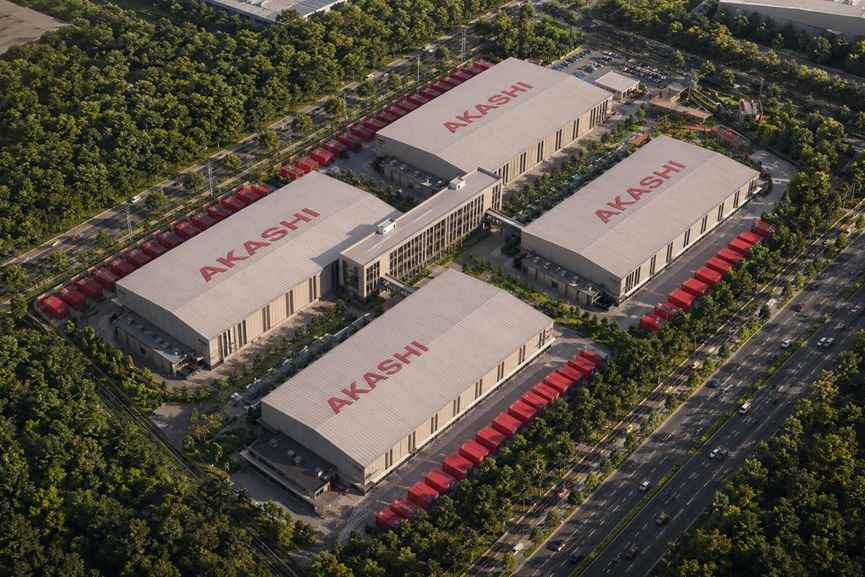
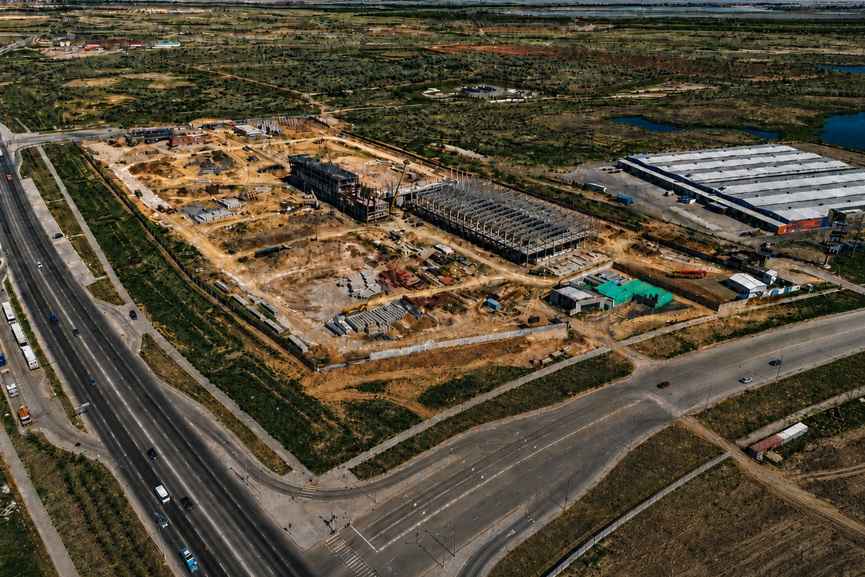
A leading example is the AKASHI Data Center being developed in Astana, Kazakhstan.
The planned campus spans 11 hectares and is designed to include four autonomous buildings, 4,224 server racks and total IT capacity of up to 100 megawatts when fully developed.
The project is being positioned to support enterprise computing, government systems, cloud platforms and advanced AI workloads.
AKASHI is important not simply because of its proposed size. Its wider significance lies in what it represents for Central Asia.
It moves the region’s infrastructure argument from potential towards physical execution. Instead of discussing only future possibilities, Kazakhstan can point to a major project designed to serve high-density computing requirements and meet internationally recognised standards.
Certification must be reported accurately
AKASHI’s first phase has received Tier IV Certification of Design Documents from Uptime Institute.
This means the submitted engineering and architectural design has been independently assessed against Tier IV design requirements.
It does not mean that the completed facility has already received full Tier IV construction or operational certification. Those stages require separate assessment after the infrastructure has been built, tested and commissioned.
This distinction does not reduce the project’s importance. Accurate reporting strengthens its credibility and avoids turning a legitimate achievement into an exaggerated claim.
The certification demonstrates that the project has reached an important design milestone. Its ultimate performance will still depend on construction quality, testing, grid reliability and operational execution.
Climate and energy efficiency
Astana’s climate may provide another competitive advantage.
Lower outside temperatures can reduce reliance on energy-intensive mechanical cooling during suitable periods. This form of ambient or free cooling can lower electricity consumption and operating costs when supported by appropriate engineering systems.
Cooling efficiency is becoming increasingly important because high-density AI servers generate substantially more heat than conventional computing equipment.
For future AI facilities, commercial viability will depend not only on the price of electricity but also on how efficiently that electricity can be converted into computing capacity.
Central Asia’s climate may strengthen its case, but the real benefit must be proven through the completed facility’s year-round energy performance, cooling design and operating costs.
Image source: AKASHI Data Center | Cropped by Team GBN
The challenges that remain
One project cannot establish an entire region as a global AI infrastructure hub.
Central Asia must still demonstrate that it can provide:
Confidence for international customers and investors
These factors will determine whether the region can attract critical workloads rather than simply construct large facilities.
The real question is not whether Central Asia possesses land and energy. It is whether those advantages can be combined with connectivity, operational reliability and institutional trust.
A wider map, not a replacement
Central Asia should not be presented as the next Singapore.
Singapore’s position rests on a mature ecosystem of finance, law, connectivity, talent and international business. A large data centre in Kazakhstan does not reproduce that system.
Central Asia offers a different proposition. Its opportunity lies in scalable land, energy access, climate conditions and its position within a wider Eurasian network.
The future of AI infrastructure is therefore unlikely to be shaped by one replacement hub. It will be built through a network of specialised locations.
Singapore can remain a business and connectivity gateway. The Gulf can become a centre of sovereign AI capital and large-scale computing. Central Asia can emerge as a location for energy-intensive infrastructure.
AKASHI does not prove that this transition is complete. But it gives Central Asia something it did not previously possess at this scale: a tangible proof point.
It shows that the region’s digital ambitions are moving beyond discussion and into physical development.
Central Asia can become one of the next important points on the global AI infrastructure map, but its success will depend on whether projects such as AKASHI can convert regional advantages into reliable, internationally competitive computing capacity.