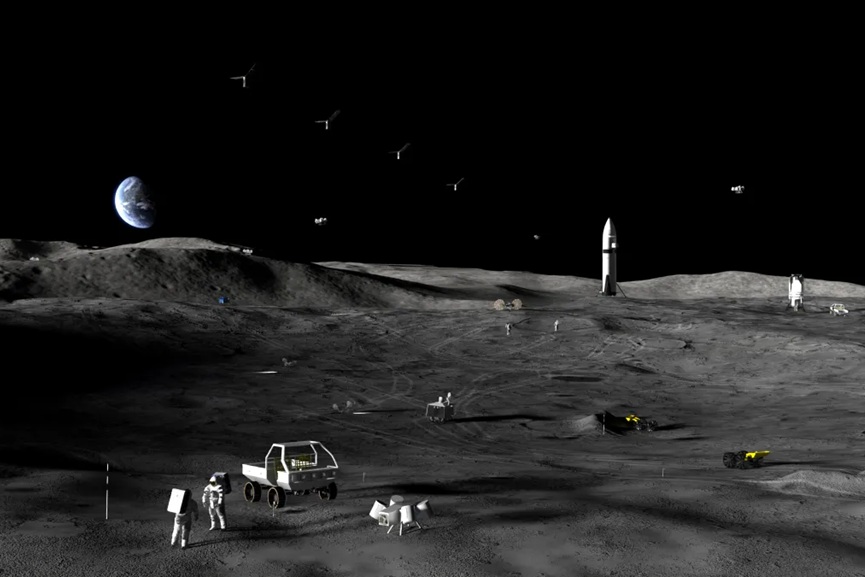
NASA has unveiled an ambitious roadmap to establish a sustained human presence on the Moon, outlining robotic missions, lunar vehicles, hopping drones, and infrastructure plans to support a semi-permanent base at the lunar south pole by 2032.
The announcement marks a major escalation in the intensifying global race to return humans to the Moon, with the United States seeking to re-establish lunar leadership ahead of China, which is targeting a crewed lunar landing by 2030.
During a Moon Base event held at NASA Headquarters in Washington, the agency detailed new contracts and mission timelines involving several commercial space companies, including Blue Origin, Astrobotic, Intuitive Machines, Astrolab, Lunar Outpost, Firefly Aerospace, and SpaceX.
Jared Isaacman, NASA Administrator, described the Moon Base initiative as humanity’s first outpost on another celestial body and said the program would support scientific discovery, technological innovation, economic development, and future crewed missions to Mars.
NASA’s broader ‘Ignition Moon Base’ strategy is divided into multiple phases, beginning with robotic exploration missions designed to map terrain, test technologies, and reduce operational risks before astronauts return to the lunar surface under the Artemis program.
Multi-phase lunar exploration plan
The first mission, Moon Base I, is scheduled for launch no earlier than fall 2026 and will use Blue Origin’s Blue Moon Mark 1 Endurance lander to deliver scientific payloads to the Shackleton Connecting Ridge near the Moon’s south pole.
The mission will test landing technologies and study how spacecraft thrusters interact with the lunar surface.
Moon Base II, targeted for later this year, will deploy Astrobotic’s Griffin lander carrying more than 1,100 pounds of cargo, including Astrolab’s FLIP rover designed to support future astronaut mobility operations.
Moon Base III will use Intuitive Machines’ Nova-C Trinity lunar lander to carry scientific payloads studying lunar swirls and surface evolution, while also featuring contributions from the European Space Agency and the Korea Astronomy and Space Science Institute.
NASA also announced contracts worth nearly $440 million combined for Astrolab and Lunar Outpost to develop the first generation of crewed and autonomous Lunar Terrain Vehicles (LTVs), which are expected to transport astronauts, move equipment, and support scientific operations across the Moon’s rugged terrain.
Astrolab’s CLV-1 rover will be capable of carrying astronauts and supplies at speeds exceeding six miles per hour, while Lunar Outpost’s Pegasus rover will support manual, autonomous, and remote-controlled operations at speeds above nine miles per hour.
To support long-term habitation, NASA plans to establish nuclear and solar power systems on the Moon, including fission reactors, enabling astronauts to live in semi-permanent lunar habitats by 2032.
The Moon’s south pole remains a key focus because of the presence of frozen water deposits, which could eventually be used for drinking water, oxygen production, and fuel generation for deeper space missions.
NASA also provided updates on ‘MoonFall,’ a mission involving four hopping drones designed to independently explore difficult lunar terrain and identify future landing zones for Artemis astronauts.
The drones, being developed by NASA’s Jet Propulsion Laboratory with transport support from Firefly Aerospace, are targeted for launch in 2028.