The United Arab Emirates (UAE) has concluded its participation in the 2025 Spring Meetings of the World Bank Group (WBG) and the International Monetary Fund (IMF), which took place in Washington, D.C., from April 21 to 26.
The Ministry of Finance and the Central Bank of the UAE (CBUAE) represented the country in the meeting, which discussed key global challenges in various areas from growth to inflation, financial sustainability, digital transformation, and climate action.
The meeting was attended by international economic leaders, including finance and development ministers, central bank governors, private sector executives, and representatives from civil society organizations.
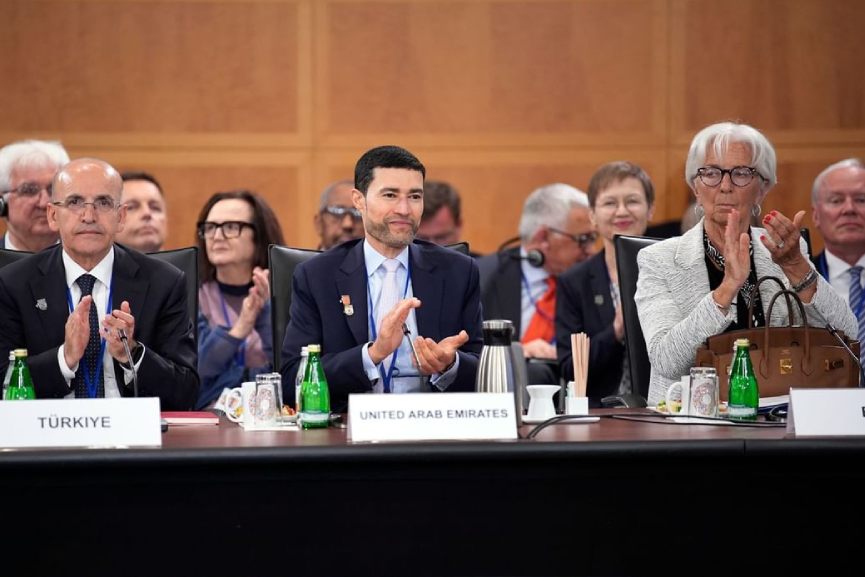
Mohamed bin Hadi Al Hussaini, Minister of State for Financial Affairs, emphasized that the UAE is committed to enhancing its international role in shaping global economic and financial policies as well as contributing to the development of a more inclusive and sustainable global financial system.
Mohamed bin Hadi Al Hussaini Minister of State for Financial Affairs UAE
“We believe that strengthening economic resilience at both regional and global levels requires broader partnerships and adaptive, multilateral cooperation. Hence, we, in the UAE, prioritize constructive dialogue with international financial institutions and are committed to developing practical, actionable solutions that support countries in addressing global challenges, particularly in the areas of sustainable economic transformation, financial governance, and investment in digital infrastructure and related policy frameworks.”
Khaled Mohamed Balama, Governor of the Central Bank of the UAE, stated that, “The UAE’s participation in the Spring Meetings reflects its firm belief in the importance of dialogue and international cooperation in economic and developmental fields to address global economic challenges. These meetings reaffirmed the importance of coordinating monetary and fiscal policies to counter inflation and market volatility.”
During the Spring Meetings, the UAE delegation also took part in the Middle East, North Africa, Afghanistan, and Pakistan (MENAP) Ministerial Meeting for finance ministers and central bank governors.
In addition to addressing regional economic challenges amid global uncertainty, the ministerial meeting explored avenues for promoting inclusive growth as well as the role of the International Monetary Fund (IMF) in supporting economic stability and advancing sustainable development.
Discussions also focused on the impact of global financial conditions, national policy strategies, and the role of international institutions in supporting reform and development initiatives.
During the meeting, Al Hussaini called for expanding the resources of the IMF’s Resilience and Sustainability Trust (RST) to cover vital areas such as employment opportunities, youth empowerment, and digital transformation. He also reaffirmed the UAE’s commitment to supporting regional and international efforts to restore growth momentum and enhance economic governance, highlighting the importance of innovation and investment in human capital and infrastructure as key pillars for achieving long-term sustainable development.
The UAE delegation also took part in the second G20 Finance Ministers and Central Bank Governors Meeting (FMCBG), which discussed several key global economic and financial issues across three main sessions. These sessions focused on macroeconomic challenges, global financial stability, the international financial architecture, developments in the multilateral development banks roadmap, and the challenges hindering development in Africa.
Highlighting the importance of the G20’s role in coordinating economic policies, Al Hussaini proposed three main steps to enhance global macroeconomic stability.
Image Via: IMF | Cropped by GBN
These included addressing uncertainty, establishing a fair and transparent global trade system that ensures equal opportunities, supporting emerging market economies and developing countries to strengthen their financial resilience, and considering the social dimensions of economic policies to achieve a balance between public finance requirements and sustainable development goals.
During a dedicated session on development challenges in Africa, Al Hussaini reiterated the UAE’s support for G20-led initiatives aimed at promoting sustainable development across the African continent.
Al Hussaini also participated in the International Monetary and Financial Committee (IMFC) meetings, which addressed the IMF’s latest assessment of the global economic outlook and financial stability.
The minister noted that successive economic shocks continue to weaken global growth and heighten market volatility, contributing to increased uncertainty and adversely affecting the investment climate and progress toward sustainable development.
He further stressed that the rising debt levels in emerging markets and low-income countries represent an escalating risk to economic stability, particularly amid high borrowing costs and constrained access to financing.
The minister noted that the UAE fully supports the IMF’s role in providing tailored assistance and guidance, taking into account their unique economic and social contexts.
Additionally, the UAE delegation held a number of high-level bilateral meetings to discuss economic and financial relations with Pakistan, Zimbabwe and the International Fund for Agricultural Development (IFAD).