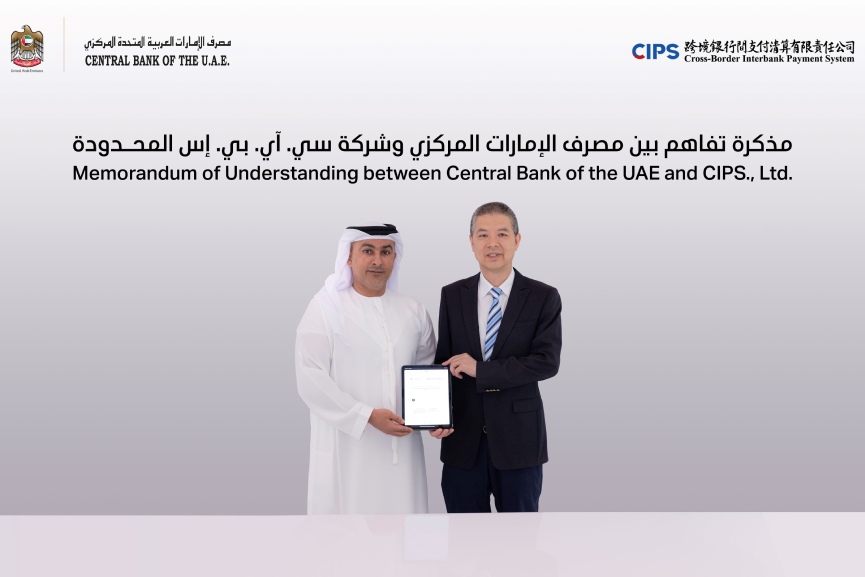
The Central Bank of the UAE (CBUAE) has inked a Memorandum of Understanding (MoU) with CIPS Co., Ltd. (CIPS), the operating institution of the Cross-Border Interbank Payment System of China, to enhance joint cooperation in cross-border payments between the two nations.
The agreement was signed by Saif Al Dhaheri, Assistant Governor for Banking Operations and Support Services at CBUAE and Xiangyang WU, Vice President of CIPS. The signing ceremony was also attended by senior officials from both entities.
Under the MoU, both entities will work together on developing initiatives that promote more seamless, efficient and cost-effective use of payment systems for cross-border transactions between the two countries.
Additionally, the agreement includes developing cooperation in risk and compliance, with an emphasis on sharing expertise to strengthen the security, safety, soundness and stability of cross-border payment infrastructures.
Saif Al Dhaheri Assistant Governor for Banking Operations and Support Services – CBUAE
“This MoU underpins both countries’ efforts to cultivate strategic partnerships and reinforce our commitment to strengthening financial, trade, and investment cooperation, in line with the vision of the wise leadership. We look forward to keeping pace with developments in the global payments landscape and leveraging technology and innovation to stimulate economic and trade growth, develop the financial services sector in both countries, create innovative financial solutions for cross-border payments settlement, and facilitate transactions and reduce costs. This will contribute to enhancing the promising prospects for sustainable development and achieving the mutual interests of the two countries.”
Xiangyang WU, Vice President of CIPS, added that, “Our cooperation with the Central Bank of the UAE will provide ample opportunities to strengthen relations between the two countries across the economic, trade, investment, financial, and banking sectors. This MoU reflects our shared desire to strengthen cooperation, exchange expertise, and leverage digital advancements to streamline the processing and settlement of cross-border financial payments more smoothly and efficiently between the two countries, and enable stakeholders to easily access payment services. This will facilitate the achievement of our common goals and support the continued prosperity of both our economies.”