Concrete, the world’s most widely used construction material and a major source of global carbon emissions, could become greener through smarter design, according to researchers at the Massachusetts Institute of Technology (MIT).
Their latest breakthrough is a 3D-printed concrete bridge that demonstrates how artificial intelligence (AI)-driven design and advanced manufacturing can reduce material use while maintaining structural strength, potentially transforming the construction industry.
Published in the journal Additive Manufacturing, the research introduces a new design framework that enables engineers to create concrete structures that today’s 3D-printers can produce directly, eliminating the need for extensive manual redesign.
Traditional concrete construction relies on labor-intensive molds and formwork. By contrast, 3D-printing deposits concrete layer by layer, placing material only where it is structurally required, reducing waste and improving efficiency.
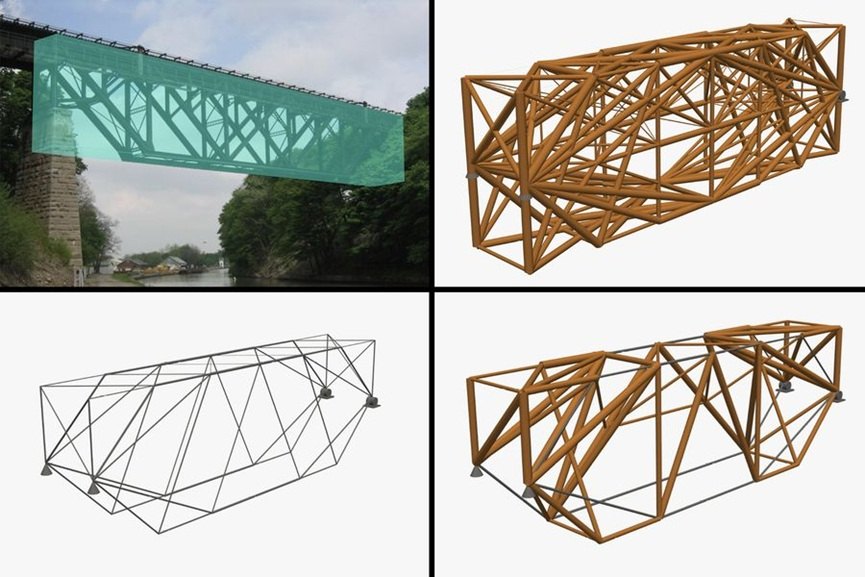
However, while computer-generated topology optimization can identify the strongest structures using the least material, many of those designs cannot be printed because current large-scale concrete printers have physical limitations, including nozzle size, turning angles and the need for continuous printing.
The MIT research overcomes that challenge by embedding these manufacturing constraints directly into the design process, producing structures that are both optimized and immediately printable.
Researchers Hajin Kim-Tackowiak and Zane Schemmer stated that previous optimization methods often produced designs that required extensive post-processing before they could be manufactured. Their new framework generates printable designs in about two minutes on a standard laptop, allowing rapid adjustments whenever project requirements change.
A bridge that proved the concept
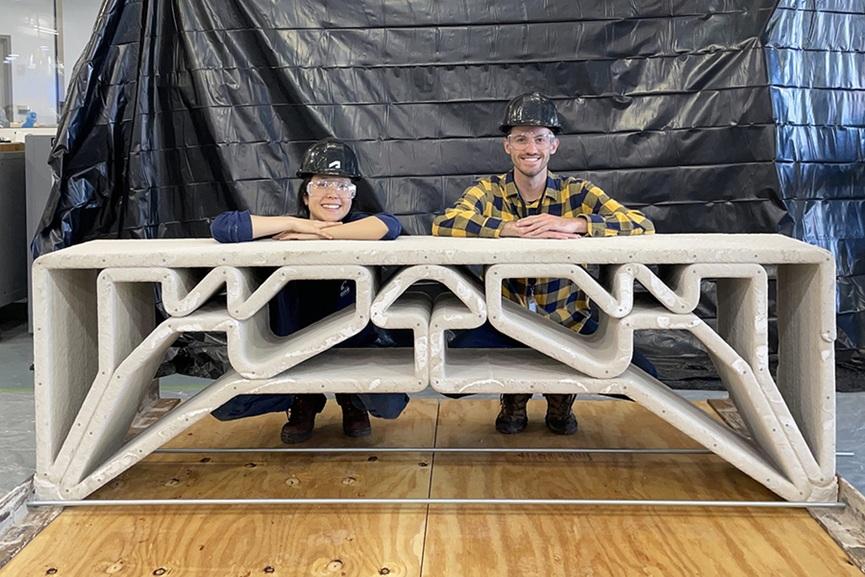
To validate the technology, the research team designed and printed a 2.3-meter-long (7.5-foot) concrete bridge using commercially available mortar at Autodesk’s large-scale 3D-printing facility in Boston. Senior researcher Josephine Carstensen stated that the bridge took approximately 30 minutes to 3D-print.
Image Credits: Haden Quinlan@LinkedIn | Cropped by GBN
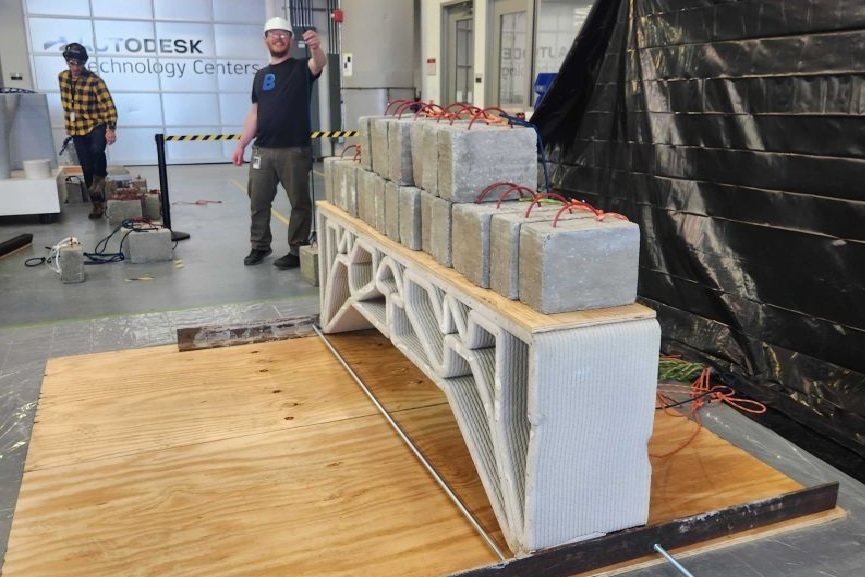
During load testing, the approximately 900-pound (410-kilogram) bridge successfully supported more than 2,000 pounds (910 kilograms) of evenly distributed concrete blocks with virtually no measurable bending, closely matching computer simulations.
The experiment also revealed an unexpected finding: today’s 3D-printing hardware, not the strength of concrete, is the primary barrier to producing lighter and more material-efficient structures.
Hardware, not concrete, is the bottleneck
The study found that printer limitations, including bead width, nozzle movement and continuous printing requirements, have a greater impact on structural efficiency than the material itself. Among those constraints, the width of the printed concrete bead emerged as the most significant factor.
Researchers found that reducing bead width from 4 centimeters to 1 centimeter could lower concrete use by as much as 76 percent while remaining within established safety margins.
Rep. Image Credits: MIT Civil and Environmental Engineering- @LinkedIn | Cropped by GBN
These findings provide a practical roadmap for manufacturers developing the next generation of large-scale construction printers, showing that relatively modest hardware improvements could significantly reduce concrete consumption, improve material efficiency and help lower the construction industry’s carbon footprint while advancing more sustainable building practices.
Building for the future
The bridge was designed so every structural element remains under compression, a condition in which concrete performs best. Following testing, the bridge fractured when one corner was lifted, demonstrating concrete’s well-known weakness under tension rather than exposing a flaw in the design.
The research team now aims to extend the framework to reinforced concrete, exploring innovative methods to integrate steel reinforcement into 3D-printed structures and further enhance their strength, durability and potential for real-world construction applications.
Rep. Image Credits: DC Studio@Magnific | Cropped by GBN
Beyond reducing material use and eliminating formwork, the researchers believe the technology could accelerate the construction of customized infrastructure, particularly in disaster relief and other situations requiring rapid deployment of durable structures.
The study highlights how combining advanced optimization algorithms with practical manufacturing constraints could pave the way for faster, more sustainable and lower-carbon construction worldwide.