Marriage conversations in the UAE often unfold against a uniquely global backdrop. Many couples here come from different countries, hold assets across jurisdictions, and carry financial responsibilities that extend beyond their immediate household. That reality has quietly begun reshaping how couples approach financial discussions before marriage.
Prenuptial agreements, once seen primarily through a Western lens or associated with high net worth divorces, are increasingly entering mainstream conversations among expatriate couples. Part of this reflects legal clarity that has emerged over recent years, which has made such agreements easier to draft and recognise. Part of it reflects something more cultural. The UAE has become a place where people build careers across decades, raise families, acquire property, and plan estates – and that permanence changes the financial questions couples ask before they marry. Longer roots invite longer thinking.
That includes conversations that previous generations often avoided. For many couples, the prenup is not the centrepiece. The conversation it encourages is what matters.
The emotional hesitation surrounding prenups remains real. Many people still associate them with distrust, as though financial clarity undermines romantic commitment. Yet the couples we interact with increasingly frame the discussion differently – less concerned about divorce itself, more focused on avoiding unnecessary conflict should circumstances change. Financial disagreements can become deeply emotional, sometimes disproportionate to the assets involved. Couples who establish expectations early often navigate difficult transitions with less friction, simply because the framework already exists.
Another common motivator is financial maturity. Couples today enter marriage with investments, businesses, property, and cross-border family obligations that did not feature as prominently in earlier generations. Discussing how those responsibilities fit within a marriageis increasingly viewed as responsible planning rather than pessimism, and even couples initially uncomfortable with the idea often find that the process itself encourages healthier financial communication, bringing conversations about savings, spending, and long-term security to the surface earlier than they might otherwise arrive.
Do prenups work under Sharia principles?
Many expatriate couples also ask how prenuptial agreements sit alongside Islamic marriage traditions. Islamic marriages already embed financial protections through the mehr, ongoing maintenance obligations known as nafaqa, and defined inheritance rules – provisions that have historically ensured a wife’s entitlements are safeguarded and estates are distributed among heirs according to fixed allocations. A prenup cannot override those inheritance rules where they apply, but financial expectations can still be documented in ways that align with Sharia principles, clarifying ownership of pre-marital assets, business interests, or debt responsibilities without infringing on mandatory distributions.
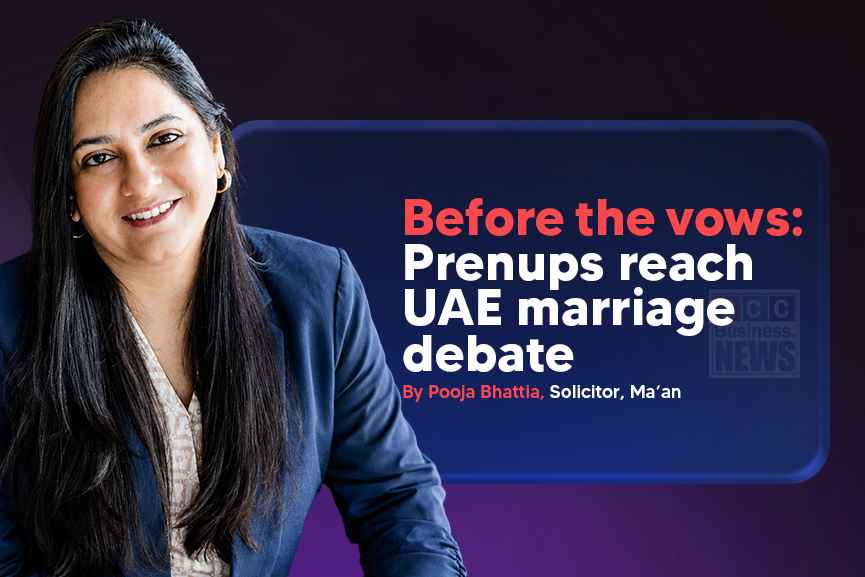
Image supplied by Ma’an | Edited and designed by Team GBN
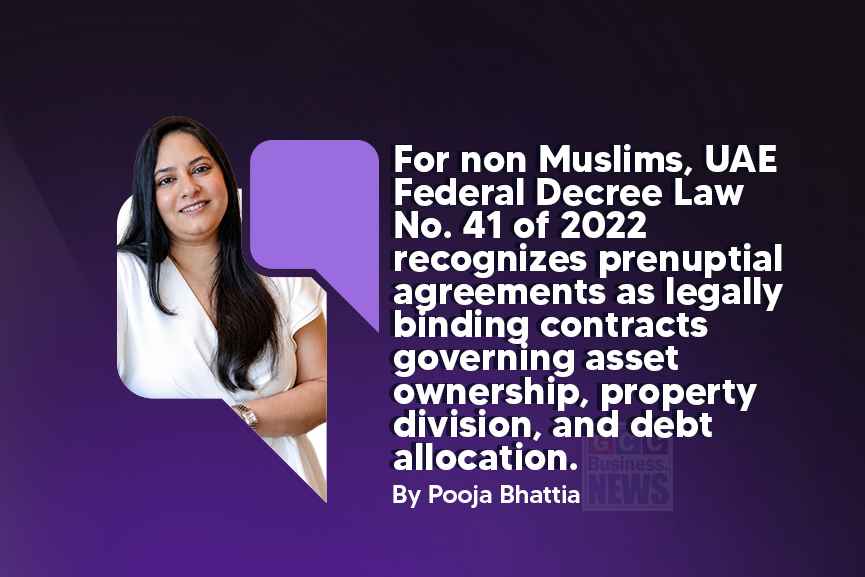
The legal foundation reflects the UAE’s duality. For non-Muslims, Federal Decree-Law No. 41 of 2022 on Civil Personal Status explicitly recognises prenuptial agreements as binding contracts covering property ownership, asset division, and debt allocation. For Muslims, they are permissible but function as supplementary instruments – guiding rather than overriding the protections already embedded in Islamic marriage. The result is a hybrid framework where modern contractual tools coexist with traditional ones, offering clarity while preserving religious obligations.
Practical clarity without cultural conflict
Cultural perceptions still shape how prenups are received. In some families, signing a legal agreement before marriage can feel emotionally counterintuitive. Marriage is traditionally viewed as a bond built on trust rather than documentation. That perspective deserves respect, yet it does not negate the practical realities many couples face today.
What we see most often is not a clash between tradition and modernity, but an effort to balance both. Prenuptial agreements are highly customisable. They can reflect personal values, family priorities, and cultural sensitivities while still providing financial clarity.
Prenups also play a role in addressing equity within marriage. They can safeguard partners who pause careers for caregiving, ensuring that contributions beyond income are recognized. They can balance power dynamics where one spouse enters the marriage with significantly greater wealth or earning capacity. In this way, prenups are not only financial documents but also tools for protecting dignity and fairness in relationships.
Timing matters too. Agreements drafted well before the wedding, with both partners receiving independent legal advice, carry significantly more weight and are far less vulnerable to later challenges. In practice, the drafting process itself often becomes a constructive exercise, encouraging couples to articulate financial values that might otherwise remain unspoken.
Representational image source: Magnific | Cropped by Team GBN
Prenups plan for stability, not anticipate failure
The misconception that prenups signal an expectation of divorce persists, yet most couples pursuing them express the opposite intention. They are seeking stability, predictability, and protection for both partners. In many cases, the agreement is less about asset division in the event of separation and more about how finances will be managed during the marriage itself.
Prenups can clarify whether assets remain separate or become joint, outline how financial liabilities are handled, and establish expectations around family support or future investments. For expatriate couples whose financial lives span multiple jurisdictions – holding property, investments, or family obligations abroad – prenups increasingly include choice of law clauses to specify which jurisdiction governs the agreement, preventing conflicting claims across borders. This clarity becomes particularly valuable in environments where professional mobility, business risk, and cross border financial ties are common.
Marriage remains an emotional commitment built on trust, shared ambition, and mutual care. Financial planning does not replace those foundations. It supports them by reducing uncertainty. Increasingly, prenups are viewed as part of broader financial planning alongside estate planning, insurance, and succession strategies, and as instruments of fairness designed to protect both partners and reduce emotional strain in times of uncertainty.
Marriage remains an emotional commitment built on trust, shared ambition, and mutual care. Financial planning does not replace those foundations. It removes the ambiguity that can quietly erode them. A couple that has worked through questions of ownership, liability, and expectation before the wedding is not hedging against failure, but choosing to enter marriage with open eyes and a shared understanding of what they are building together. It is, in its own way, an act of care.
About Pooja Bhattia
As Ma’an’s in-house Solicitor, Pooja Bhattia leads all legal matters with precision and empathy. A dual-qualified legal professional – Advocate registered with the Bar Council of Maharashtra & Goa and Solicitor with The Bombay Incorporated Law Society – she is also officially listed on the DIFC Courts website. With over 20 years of experience spanning real estate law, corporate matters, family agreements, and inheritance planning, Pooja brings both depth of expertise and a calm, reassuring presence to her work.
Image supplied by Ma’an | Edited and designed by Team GBN
She assists clients in drafting and registering Wills, guiding families through the legal steps that follow a loved one’s passing, and managing property transfers and inheritance documentation, ensuring every process reflects both the law and the individual’s wishes. Having worked closely with families, business owners, and developers, Pooja is known for simplifying complex legal procedures and delivering solutions that are clear, practical, and sensitive to each client’s circumstances. Her work is driven by a singular aim: helping people find clarity, confidence, and peace of mind during life’s most important transitions.
About Ma’an
Ma’an Legacy & Legal Consultancy is an intergenerational wealth and legacy planning platform founded by Nazneen Abbas, a certified financial advisor with over four decades of experience. Built on the belief that a Will is more than a legal formality, Ma’an helps families and business owners structure their wealth with empathy, clarity, and foresight.
The firm brings together financial, legal, and accounting expertise to offer holistic solutions in estate planning, business succession, and legacy preservation. With a team led by founder Nazneen Abbas, Solicitor Pooja Bhattia, and a consultant Chartered Accountant, Ma’an serves families across the Gulf, ensuring that every plan reflects not just assets, but the values and continuity they represent.