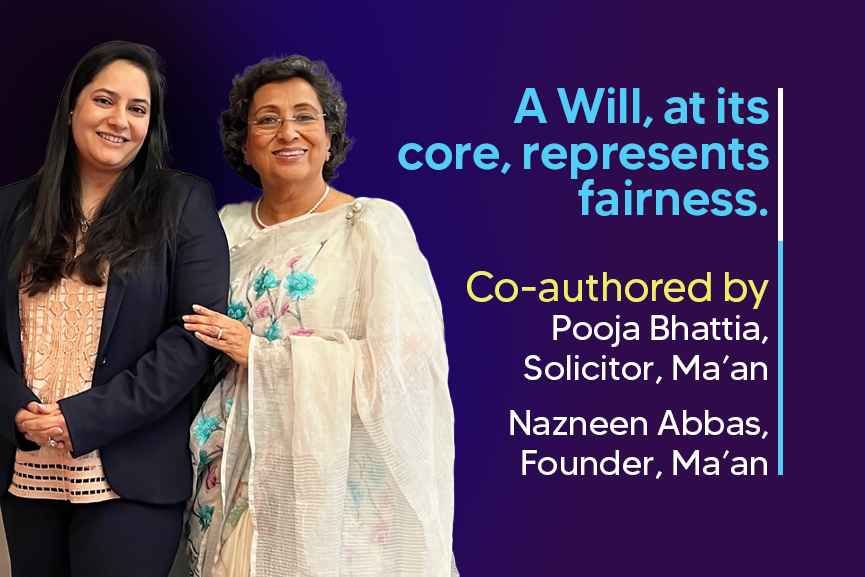
A Will, at its core, represents fairness – or at least that’s how most people perceive it. When individuals declare that their assets should be divided “equally” among family members, it sounds simple, even noble.
Yet, in practice, equal is not always fair. Families are complex, assets vary in liquidity and location, and circumstances change. What begins as an act of clarity can, without careful structuring, become a source of contention.
Most people think of Wills as a checklist, a list of names, properties, and percentages. But a Will is far more than that. It is a legal instrument that dictates how your life’s work transitions into the hands of others. The question is not just who gets what, but how that transfer happens, under what conditions, and with what emotional and financial consequences. That’s where the difference lies between a generic Will and one that has been thoughtfully constructed.
Take the case of real estate. Families can own multiple properties, sometimes jointly, sometimes across jurisdictions. In the event of death, each heir inherits an undivided share, which sounds equitable on paper but can quickly lead to gridlock. One heir may wish to sell, another may prefer to keep it for sentimental reasons, and a third may lack the liquidity to pay transfer fees or taxes associated with inheriting property.
Without specific language addressing such realities, the property risks being locked in limbo or sold under duress. A well-crafted Will anticipates these possibilities and provides a mechanism to resolve them. For instance, allowing an heir to buy out another’s share, or making provisions for liquidity to cover associated costs.
Image courtesy of EM’s FP | Altered and designed by Team GBN
When business can become family tension
Businesses present an even more delicate challenge. Entrepreneurs spend decades building companies that often double as family legacies. When the next generation inherits equal shares, the assumption is that ownership automatically translates into alignment. In reality, one child might be actively running the business, while another has no interest or expertise. If the structure doesn’t differentiate between ownership and involvement, resentment can brew.
The active child may feel unfairly burdened, while the others enjoy returns from an enterprise they no longer contribute to. To avoid such rifts, some Wills incorporate provisions that require a professional valuation of the business at the time of the owner’s death. This allows for a buyout option; those committed to continuing the enterprise can compensate siblings who wish to step away. It also clarifies succession, protecting both the business’s future and the family’s relationships.
The need for liquidity and balance
A family’s wealth is rarely uniform; it may include real estate, equity, cash, and cross-border assets. When each heir’s inheritance differs in liquidity or location, an equal division can still produce imbalance. A financial buffer, established within the estate plan, can serve as an equalizer, ensuring that one heir’s immovable property corresponds fairly with another’s cash-based bequest.
Such mechanisms are invaluable when taxes, transfer costs, or jurisdictional barriers complicate distribution. This also extends to families with global ties. Many heirs today are residents or citizens of other countries, each with its own tax treatment for inherited wealth. Without planning, an inheritance meant as a gift can expose a beneficiary to substantial tax liabilities abroad. Provisions that account for this, through dedicated funds or cross-border planning tools, ensure that inheritance is a blessing, not a burden.
From paperwork to legacy planning
At its heart, this is what true legacy planning means: understanding that fairness isn’t mathematical. It’s situational. It reflects awareness of liquidity, taxation, family temperament, and future intent. Equal shares on paper may give the illusion of justice, but only thoughtful provisions bring peace in practice.
Image courtesy of EM’s FP | Altered and designed by Team GBN
Many families overlook these nuances because Will-writing has become a routine exercise. In fast-moving economies like the UAE, where people buy and sell assets frequently, a rigid Will can create more problems than it solves. A well-considered document allows flexibility, directing that assets be valued at the time of death, accounting for who holds liquidity, and recognising that each beneficiary’s needs may differ.
The conversations that matter
The discussions that lead to a sound Will are often intimate and sometimes uncomfortable. They involve practical questions: who will manage the business, who has liquidity, who faces tax exposure abroad. Addressing them in advance prevents confusion later. A good Will is not a reflection of sentiment, but of foresight. It helps families act with clarity when emotions run high.
In the end, the goal of legacy planning is not just to distribute wealth but to preserve stability. It ensures that the next generation inherits clarity instead of conflict and that the relationships you built in life remain intact long after. And this should be Step Zero of every legacy planning conversation.
About Pooja Bhattia
As Ma’an’s in-house Solicitor, Pooja Bhattia leads all legal matters with precision and empathy. A dual-qualified legal professional – Advocate registered with the Bar Council of Maharashtra & Goa and Solicitor with The Bombay Incorporated Law Society – she is also officially listed on the DIFC Courts website.
With over 20 years of experience spanning real estate law, corporate matters, family agreements, and inheritance planning, Pooja brings both depth of expertise and a calm, reassuring presence to her work. She assists clients in drafting and registering Wills, guiding families through the legal steps that follow a loved one’s passing, and managing property transfers and inheritance documentation, ensuring every process reflects both the law and the individual’s wishes.
Having worked closely with families, business owners, and developers, Pooja is known for simplifying complex legal procedures and delivering solutions that are clear, practical, and sensitive to each client’s circumstances. Her work is driven by a singular aim: helping people find clarity, confidence, and peace of mind during life’s most important transitions.
About Nazneen Abbas (Ma’an)
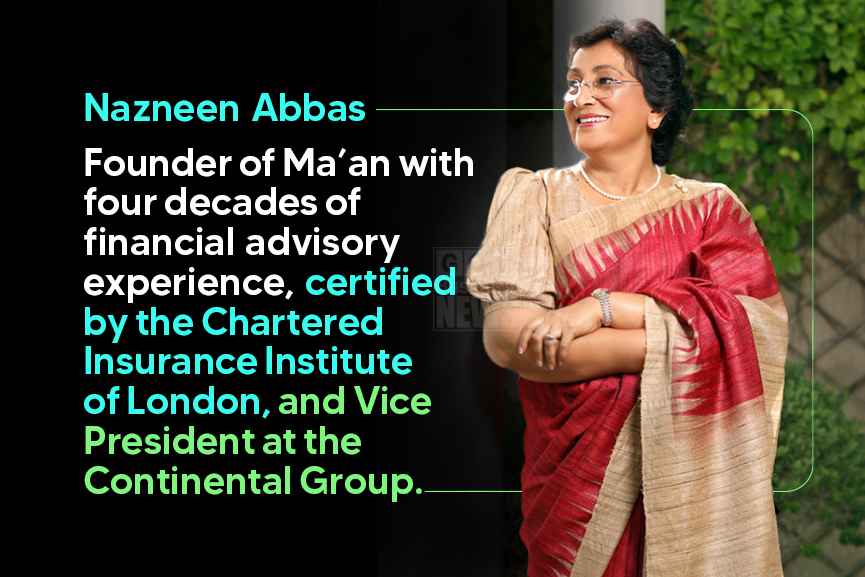
Nazneen Abbas is the founder of Ma’an, an intergenerational financial planning platform shaped by expert professional insight and her own personal experiences. With over four decades in financial advisory, Nazneen has long worked at the intersection of wealth, legacy, and family dynamics, but it was her own life that gave this work its deeper meaning.
Widowed in her thirties, she experienced firsthand how emotionally and logistically unprepared families can be when it comes to succession. That chapter shaped her belief that legacy planning needs to stretch beyond a legal checklist and reflect the lives, values, and aspirations of those it’s meant to protect. Ma’an was built on that belief. Today, the platform serves families from diverse social and economic backgrounds including high-net-worth individuals and businesses spanning across the Gulf.
Ma’an helps them structure their wealth across generations with empathy, clarity, and continuity at the core. Nazneen is a certified financial advisor from the Chartered Insurance Institute of London. She also serves as Vice President at the Continental Group, where she leads initiatives in estate and succession planning.
Ma’an is dedicated to continuous growth and excellence, bringing together a powerhouse of expertise. With Nazneen’s financial planning acumen, Solicitor Pooja Bhattia’s proficiency, coupled with the services of a consultant Chartered Accountant ,Ma’an Legacy & Legal Consultancy stands as a trusted partner committed to delivering tailored, effective solutions for intergenerational succession planning.
About Ma’an
Ma’an Legacy & Legal Consultancy is an intergenerational wealth and legacy planning platform founded by Nazneen Abbas, a certified financial advisor with over four decades of experience. Built on the belief that a Will is more than a legal formality, Ma’an helps families and business owners structure their wealth with empathy, clarity, and foresight.
The firm brings together financial, legal, and accounting expertise to offer holistic solutions in estate planning, business succession, and legacy preservation. With a team led by founder Nazneen Abbas, Solicitor Pooja Bhattia, and a consultant Chartered Accountant, Ma’an serves families across the Gulf, ensuring that every plan reflects not just assets, but the values and continuity they represent.






 Ma’an helps them structure their wealth across generations with empathy, clarity, and continuity at the core. Nazneen is a certified financial advisor from the Chartered Insurance Institute of London. She also serves as Vice President at the Continental Group, where she leads initiatives in estate and succession planning.