QatarEnergy has signed an agreement with Samsung C&T’s Engineering & Construction Group (Samsung C&T) for the construction of a world-scale solar power plant in Dukhan, about 80 kilometers west of Doha, supporting Qatar’s renewable energy and sustainability goals.
The Dukhan solar power plant, one of the largest in the world, will be developed in two phases, reaching a total electricity generation capacity of 2,000 megawatts (MW) by mid-2029.
Once completed, it will double Qatar’s solar power production capacity, contributing significantly to the country’s renewable energy goals.
The project is set to play a key role in advancing Qatar’s renewable energy ambitions, contributing to sustainable power generation, reducing carbon emissions, and supporting the country’s transition toward a cleaner and more diversified energy mix.
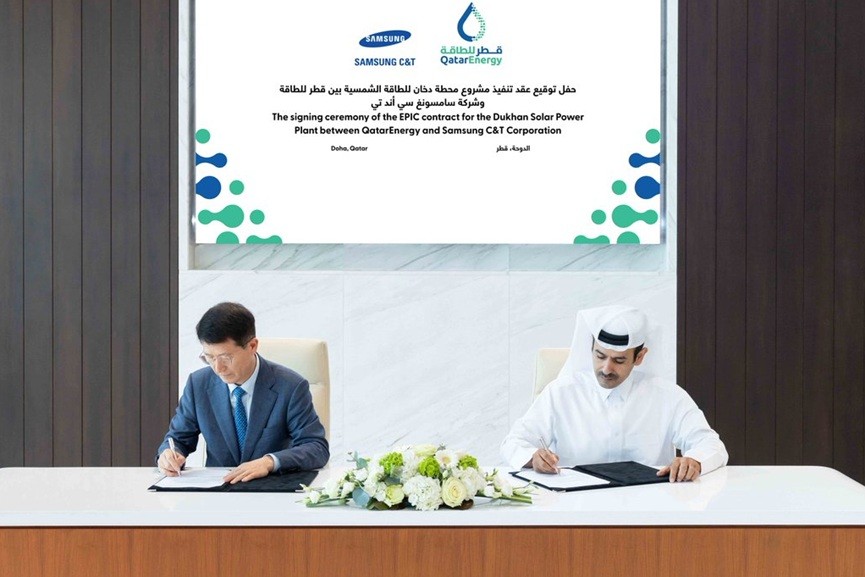
The agreement was signed by Minister of State for Energy Affairs and President and CEO of QatarEnergy HE Eng. Saad Sherida Al-Kaabi and President and CEO of Samsung C&T Sechul Oh during a special ceremony held at QatarEnergy’s headquarters in Doha.
The event was attended by HE President of Kahramaa Abdulla bin Ali Al-Theyab and senior executives from both companies.
HE Saad Sherida Al-Kaabi Minister of State Energy Affairs President and CEO QatarEnergy
“This agreement is an important milestone in our effort to manage the environment in a manner that balances economic and social development with environmental protection, as stipulated by Qatar National Vision 2030. It also supports one of the key goals of QatarEnergy’s Sustainability Strategy, which is to generate more than 4,000 megawatts of renewable energy by 2030. When completed, the Dukhan solar power plant, along with Al-Kharsaah, Mesaieed, Ras Laffan solar power plants will help reduce carbon dioxide emissions by about 4.7 million tons annually, while contributing up to 30 percent of Qatar’s total peak electricity demand. We are pleased to collaborate with Samsung C&T to help achieve this vision.”
The Dukhan solar power plant will begin the first phase of production by dispatching 1,000 MW of power to the KAHRAMAA grid towards the end of 2028. The new plant will utilize a solar tracker system and will enhance efficiency by installing inverters capable of operating flawlessly in a high-temperature environment