The Global Carbon Council (GCC) and Bhutan have entered into a partnership to strengthen the latter’s institutional and technical readiness for participation in international carbon markets.
The focus of the agreement will be on capacity development, carbon market governance, methodologies, project development, registration and issuance processes, and digital registry infrastructure.
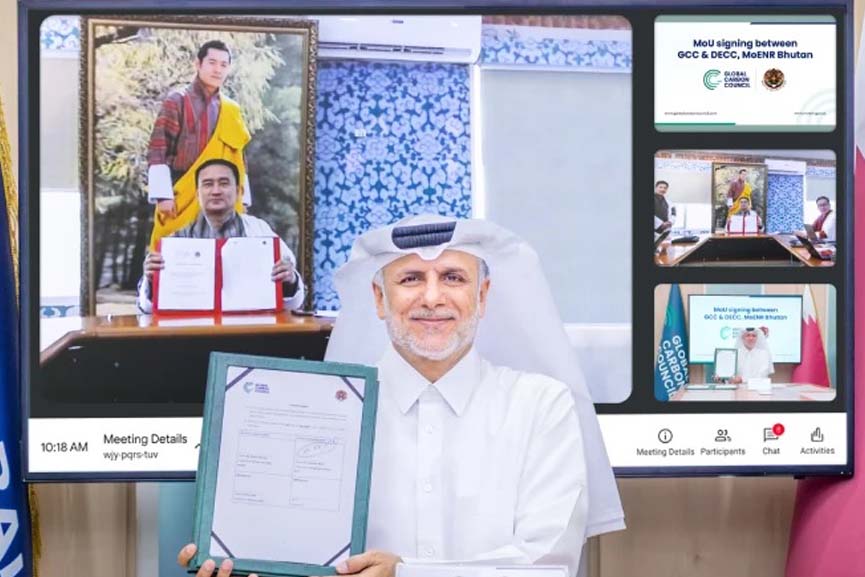
Qatar-based Global Carbon Council (GCC), an independent, internationally recognized carbon standard in the Global South, has signed an MoU with Bhutan’s Department of Environment and Climate Change (DECC), the country’s designated national authority for Article 6 of the Paris Agreement.
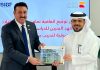
“Signed by Dr. Yousef M. Alhorr, Founding Chairman of GCC and Karma Tshering, Hon’ble Secretary, Ministry of Energy and Natural Resources, Royal Government of Bhutan, the MoU aims to strengthen Bhutan’s institutional and technical readiness for participation in international carbon markets, with a focus on capacity development, carbon market governance, methodologies, project development, registration and issuance processes, and digital registry infrastructure,” GCC said in an emailed statement.
The partnership seeks to translate Bhutan’s climate ambition into credible and scalable carbon market action by bringing together DECC’s national mandate and GCC’s experience in carbon crediting standards, methodologies, project assessment, and market infrastructure.
Dr. Yousef M. Alhorr, founding chairman of the Global Carbon Council, said that, “Bhutan has demonstrated exceptional environmental leadership through its enduring commitment to net zero. This collaboration will support the country in translating that ambition into credible and scalable carbon market action. By combining strong national ownership with high-integrity standards, methodologies, and interoperable infrastructure, we aim to help mobilise climate finance while safeguarding environmental integrity and sustainable development.”
Under the MoU, GCC will conduct capacity-building workshops and training on GCC standards, rules and requirements, the project development cycle, registration and issuance processes, registry infrastructure, and methodology development.
The parties will also explore cooperation to support the adoption of relevant GCC standards, governance arrangements, and methodologies for Bhutan’s carbon market. This is intended to strengthen national technical capabilities and facilitate the development of mitigation activities capable of generating measurable and independently verified greenhouse gas emission reductions and removals.
Another key area of cooperation is the potential adoption of GCC’s Carbon Market Infrastructure and interoperable national registry solution to support the operationalization of Article 6.2 of the Paris Agreement. Any implementation of the infrastructure will be subject to a separate agreement between the parties.
“This collaboration represents an important step in strengthening Bhutan’s institutional and technical readiness for international carbon markets. Through capacity development, knowledge exchange, and access to credible standards and infrastructure, we aim to ensure that Bhutan’s participation in carbon markets supports national priorities, maintains environmental integrity, and contributes to sustainable development,” said Karma Tshering, Hon’ble Secretary, Ministry of Energy and Natural Resources, Royal Government of Bhutan.
Furthermore, the parties will develop program-specific work plans defining their respective activities and responsibilities under the MoU. Through this framework, GCC and DECC seek to establish a strong foundation for transparent, inclusive, and internationally aligned carbon market action in Bhutan.