The global digital marketing market, valued at USD 780 billion in 2023 and projected to reach USD 1.1-1.2 trillion by 2030, according to MarkNtel Advisors, highlights rapid growth.
Yet beyond this expansion, the real question is what entrepreneurs must understand to navigate its realities. This article examines that in depth.
In today’s environment, where digital marketers are everywhere, entrepreneurs must be extremely cautious. Beyond persuasive language, inflated digital presence, and polished presentations, the real question is simple: how capable is the digital marketer in front of you of actually generating ROI? What proven track record do they have in delivering successful projects? Are they willing to provide transparency that can be verified and examined?
Do we truly understand that, on average, conversion rates in digital advertising are only around 2% to 5%? Of course, this can vary depending on the nature of the product and campaign objective, but the underlying reality remains the same. A large proportion of participants in digital marketing fail to achieve meaningful returns.
Before spending, entrepreneurs must ask fundamental questions. Why am I advertising in the digital space? Does my target audience actually exist there? Am I choosing platforms where potential buyers or future customers are actively engaged?
It is equally important to understand that some users are harder to reach through digital ads. Subscribers to ad-free services such as YouTube Premium, along with users who rely on ad blockers or limit personalized advertising through privacy settings, remain largely outside the reach of conventional digital campaigns.
Image source: EM’s FP account | Cropped and designed by Team GBN
Even individuals like the author of this article actively use ad blockers, remove ad interests, and restrict personalized ads. For these audiences, traditional targeting becomes weaker and measurement less reliable.
This raises a strategic question. Have you built alternative pathways to reach them through organic content, influencer marketing, direct traffic, and contextual advertising? Or are you relying solely on paid campaigns, which are losing precision?
The question, then, is whether these realities are taken into account when allocating digital marketing budgets. If not, the outcome is predictable. You risk becoming part of the majority of entrepreneurs who spend on digital marketing without achieving sustainable results.
Key realities to understand
Before you proceed with digital marketing, you must first evaluate whether the ‘successful examples’ presented by digital marketers are actually relevant to your own purpose.
More importantly, you need to consider whether the people who spend time in the digital space are even likely to buy the product or service you are offering.
When you raise this point, digital marketers often respond with examples of brands like Rolls-Royce, Bugatti, Pagani, Lamborghini, and perfume brands such as Clive Christian and Creed Aventus, claiming that even these companies advertise online.
What you need to understand is simple: these brands do not rely on digital advertising primarily for direct sales.
Image source: EM’s FP account | Cropped by Team GBN
Their digital presence is part of a larger strategy to build jealousy, aspiration, status, authority, and emotional influence. The goal is long-term perception, with conversion as a secondary outcome. So don’t assume that digital advertising always exists to drive immediate sales.
Consider Bugatti as an example
Many people notice Bugatti ads on social media or YouTube. But these ads are not meant to make you buy the car. In fact, the brand already knows that most viewers cannot afford it.
So why advertise? The goal is not immediate sales. The goal is to build brand power and perception.
Only a very small number of people in the world can actually buy a Bugatti. But even those buyers are influenced by what society sees as “ultimate luxury.” Through ads, media, films, and online platforms, brands slowly shape this idea in people’s minds.
This is called aspirational branding. Bugatti is not presented as just a car. It is presented as a symbol of success, status, and achievement. Over time, people begin to associate the brand with the highest level of success, even if they never plan to buy it.
Representational image | Source: EM’s FP account | Cropped by Team GBN
This wider public perception plays an indirect role. It reinforces the brand’s image and keeps it at the top of the luxury market. When a potential buyer is ready, that strong image already exists in their mind.
So the impact is not immediate. It works slowly, through influence and perception. in simple terms, luxury brands sell products to a few people, but they sell the idea of success to everyone.
The relevance of follower count
Is there any real value in increasing followers on social media pages through paid ads? If you are a serious businessperson, the honest answer is not zero, but very limited. It can offer some short-term benefits, such as initial visibility or basic social proof, but it does not create a meaningful business impact on its own.
It only becomes useful if your goal is to claim your page has one million followers and use that number to attract ads, promotions, or to mislead others. In that case, paid follower growth serves as a facade rather than a strategy.
Paid campaigns can support early-stage growth and help reach targeted audiences. However, if those followers are not relevant or actively engaged, increasing follower count alone does not generate meaningful business results. In many cases, it can become counterproductive.
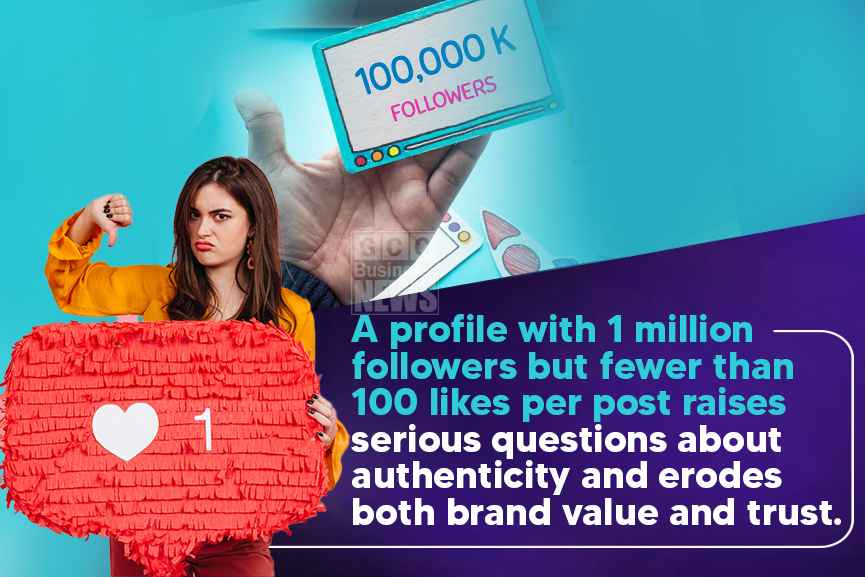
For example, a page with one million followers but fewer than 100 likes per post clearly indicates weak engagement and a largely inactive or irrelevant audience. This mismatch indirectly harms the brand or product by weakening credibility and reducing trust among the audience.
Arshad Khader, a digital marketing consultant with over 10 years of experience, says there is far greater value in building followers organically by consistently publishing content that aligns with the brand and engages a relevant audience. This approach improves engagement, strengthens credibility, and supports long-term growth. However, it takes time, which leads many to rely on paid campaigns or artificial methods to accelerate growth.
This is where risk begins
Image source: EM’s FP account | Cropped and designed by Team GBN
First, modern platform algorithms, including those used by Meta Platforms, evaluate audience quality through behavioral signals such as engagement rate, interaction consistency, and content performance. While platforms may not explicitly label followers as “organic” or “paid,” low-quality or inactive audiences are reflected in weak engagement metrics.
Second, content distribution is largely influenced by engagement. Posts that receive meaningful interactions are more likely to be promoted to wider audiences. Pages with active, relevant followers consistently perform better in reach and visibility.
Third, follower count alone does not translate into performance. Metrics such as likes, comments, shares, watch time, and readership determine actual impact. Increasing followers through poorly targeted campaigns or artificial methods does not improve these core indicators and, in some cases, can even weaken performance and negatively impact the brand.
This gap between follower count and actual engagement becomes clear when analyzing the social media pages of many well-known companies, where large audiences often coexist with low levels of interaction.
As part of the research behind this article, one such Instagram page analysis result is presented below:
The reality
Company Instagram page: 73.5K followers
Expected engagement rate: 1%–3%
Expected performance: 700–2,000 likes per post
Actual performance: ~100 likes per post
Engagement rate: ~0.13%
This is significantly below industry expectations. Such a mismatch can negatively impact brand perception and credibility.
What This Indicates: Audience quality may be poor, Content strategy may be ineffective, or both.
Why this happens
Representational image | Source: EM’s FP account | Cropped by Team GBN
Poor audience acquisition
Follower growth driven by:
Giveaways
Follow-for-follow tactics
Low-quality paid campaigns
Bot traffic
This attracts users who have little to no interest in the content.
Content audience mismatch
The content does not align with the audience’s expectations or values.
Passive or inactive audience
A large portion of followers are not actively engaging with content.
Algorithm suppression
Low engagement signals reduce content reach over time.
Content format issues
The format may not be optimized for engagement or platform behavior.
ROI is getting worse
For years, platforms such as Meta Platforms and Google delivered a powerful combination of cheap reach and measurable conversions. That advantage is no longer as strong as it once was.
Advertising costs have increased steadily. Cost per thousand impressions and cost per click have risen as competition intensified. At the same time, conversion rates have declined in many categories due to audience saturation and declining engagement quality.
The result is simple and uncomfortable. Businesses are now spending more to achieve the same or even worse outcomes.
This is not a temporary fluctuation. It is a structural shift. Small and mid-sized businesses, which once relied heavily on digital ads for growth, are increasingly pulling back or becoming more selective with budgets.
Privacy changes broke the system
Representational image | Source: EM’s FP account | Cropped by Team GBN
A major turning point came with Apple’s iOS 14.5 update, which introduced App Tracking Transparency.
This change significantly limited cross-app tracking. Retargeting became weaker. Customer journey tracking became fragmented.
Earlier, advertisers could track a user from ad to click to purchase with reasonable clarity. Now, much of that journey is partially hidden.
In practical terms, businesses are guessing more than they are measuring.
This reduction in tracking accuracy has weakened attribution models, reduced confidence in performance data, and directly impacted spending efficiency. The reality is that entrepreneurs who still assume digital ads offer perfect measurability are operating on outdated assumptions.
Too many advertisers, Limited attention
This is basic economics. Supply has increased, but demand has not grown at the same pace.
Ad inventory has expanded across platforms, but user attention remains finite. People are not spending proportionally more time consuming ads.
Feeds are now overcrowded. Users scroll faster. Ad fatigue has increased significantly.
The outcome is predictable. More competition leads to higher costs and lower effectiveness.
This creates a natural ceiling. Not every advertiser can win anymore. Only those with strong strategy, compelling creatives, and well-optimised funnels are able to sustain performance.
The reality about social media
There was a widely accepted assumption that every business would eventually rely on social media advertising as a primary growth engine.
That assumption has proven to be flawed.
Not every business generates meaningful ROI from social media. In many cases, alternative channels perform better, including search-based advertising, direct sales models, partnerships, and even offline strategies.
For mid-level brands, social media is no longer a strong platform even for visibility and attention. The main reason is simple, there is a lack of truly compelling creative content that can capture and hold people’s interest. If you reflect on your own social media usage and ask how many ads you actually remember, the reality becomes clear.
This explains why many businesses entered digital advertising, failed to achieve results, and eventually reduced or stopped spending. Growth in advertiser numbers has slowed because outcomes have become selective.
Users are harder to reach than you think
Representational image | Source: EM’s FP account | Cropped by Team GBN
It is equally important to understand that some users are structurally difficult to reach through digital ads.
Subscribers to ad-free services such as YouTube Premium, along with users who rely on ad blockers or restrict personalised advertising, remain largely outside the reach of conventional campaigns.
Even individuals like the author of this article actively use ad blockers, remove ad interests, and limit tracking. For these audiences, traditional targeting becomes weaker and measurement less reliable.
This is not a small segment. It is a growing behaviour trend.
Shift toward owned and Organic ecosystems
Smart businesses are already adapting.
Instead of relying only on paid advertising, they are investing in assets they control.
This includes:
Content platforms such as YouTube and blogs
Search engine optimisation for long-term traffic
Email databases and first-party data
Communities on platforms like WhatsApp and Discord
Influencer and creator partnerships
Authentic, organic traffic-driving content
For example, a company may choose to build a YouTube channel instead of continuously buying YouTube ads, or collaborate with creators instead of running Meta campaigns. This shift reduces dependency on paid media and improves long-term efficiency. It also explains why growth in digital ad spend is no longer as aggressive as before.
Platform saturation and Trust issues
User behaviour is shifting in ways advertisers can no longer ignore. People are increasingly skeptical of ads. They trust individual creators more than brands. For example, a product recommended by a YouTuber or Instagram creator often gets more attention and conversions than a direct brand ad.
Representational image | Source: EM’s FP account | Cropped by Team GBN
At the same time, more meaningful engagement is moving into private spaces such as WhatsApp, Telegram groups, Instagram DMs, and closed communities. Conversations, recommendations, and buying decisions are happening there, not in public comment sections.
Another growing concern is traffic quality. Many advertisers report issues like:
Fake clicks from bots
Low-quality leads
Inflated impressions with little real impact
For example, a campaign may show thousands of clicks, but very few real inquiries or conversions. This raises doubts about how “real” that traffic actually is.
All of this creates a serious challenge. Advertisers are starting to question whether platforms are delivering genuine value. As a result, many are reducing budgets or spreading spending across multiple channels rather than relying on a single platform.
Hiring new marketers: Worth or Risky?
Giving opportunities to new digital marketers can be beneficial in many ways. They often bring fresh energy and new ideas. Early success is also important for them, as it supports their growth and long-term survival.
However, this should not be done blindly. Entrepreneurs must have the time and systems to properly evaluate and audit their work. Only then should such opportunities be given.
It is also important to understand that digital marketing is relatively easy to learn at a basic level, and starting independently is accessible. Because of this, a large number of people are entering the field. Many may be capable, but not all are proven.
When assigning work to new marketers:
Spend time in detailed discussions
Clearly explain your goals and expectations
Make sure they fully understand the objective
Monitor performance regularly
Ask for measurable results, not activity reports
Pay based on milestones or performance
Also, conduct regular audits and monitor performance consistently. Avoid paying commissions or service fees upfront beyond basic platform costs. Instead, link payments to successful outcomes or clearly defined milestones.
In simple terms, give opportunities to new talent, but only with proper evaluation, clear communication, and controlled risk.
The real conclusion
Image source: EM’s FP account | Cropped and designed by Team GBN
Digital marketing has not failed. What has failed is the way people expected it to work.
Earlier, growth was easy. Ads were cheaper, reach was higher, and results were more predictable. That phase is over.
Today, the reality is different:
Costs are higher
Competition is intense
Tracking and measurement are less accurate
Returns are no longer guaranteed
For example, spending money on ads today does not automatically bring sales. It depends heavily on strategy, content quality, and audience relevance.
Because of this, many businesses that relied on shortcuts or quick results are struggling or exiting.
On the other hand, serious businesses are adapting. They are focusing on better content, stronger brand positioning, and long-term strategy instead of quick wins.
Key realities to understand
Digital marketing no longer guarantees results through scale alone
Conversion rates remain low, typically around 2% to 5%
Tracking and attribution are less reliable than before
Customer attention is limited and fragmented across platforms
Paid ads are becoming less effective as a standalone strategy
Owned media and direct audience relationships are becoming critical
Execution quality now matters more than budget size
In simple terms, digital marketing still works. But it now rewards strategy, consistency, and quality, not just spending.