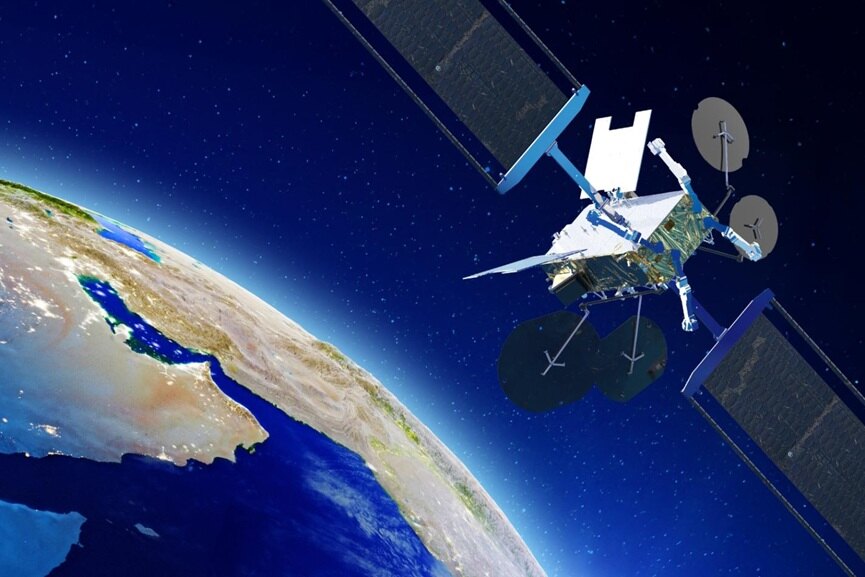
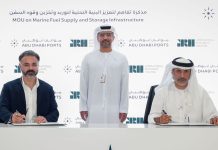
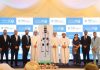
Es’hailSat, the Qatar Satellite Company, has signed a contract with Thales Alenia Space, the joint venture between Thales and Leonardo, to develop a next-generation software-defined communications satellite based on the Space INSPIRE platform.
The satellite, named Eshail-3/Türksat-Biruni, will provide high-speed broadband connectivity services across Europe, Africa, Central Asia, and the Middle East. The project will be shared with Turkish satellite operator Türksat.
The satellite will be based on the Space INSPIRE (INstant SPace In-orbit REconfiguration) platform, developed by Thales Alenia Space.
The platform enables software-defined operations and allows in-orbit reconfiguration of satellite resources to adjust coverage and capacity according to service requirements.
Es’hailSat stated that the system will support flexible allocation of resources and enable the delivery of communications services across different markets throughout the satellite’s operational life.
Under the contract, Thales Alenia Space will act as the prime contractor. It will be responsible for the design, manufacturing, testing, and delivery of the satellite. It will also provide the ground segment and related services.
Ali Ahmed Al-Kuwari President and CEO Es’hailSat
“The signing of this contract with Thales Alenia Space marks a defining moment for Es’hailSat and for Qatar’s ambitions as a leading satellite service provider. Eshail-3/Türksat-Biruni will not only expand our coverage and capabilities into new strategic markets but also strengthen the resilience and independence of Qatar’s communications infrastructure.”
Hervé Derrey, President and Chief Executive Officer of Thales Alenia Space, remarked that, “The contract is significant for Thales Alenia Space as it recognizes our ability to offer an innovative, fully digitalized telecommunications satellite that can be reprogrammed in orbit, along with the capability to integrate hosted payloads serving both commercial and governmental requirements.”
The Space INSPIRE product line was developed with support from the French space agency CNES and the Programme d’Investissements d’Avenir (PIA).
It also received support from the European Space Agency (ESA) through the ARTES programs under the Connectivity and Secure Communications directorate. The electrical propulsion module was developed with support from the UK Space Agency.