A finance leader who led reporting across 10 legal entities and helped a trading firm meet institutional standards explains how weak reporting turns scaling into risk.
At Davos in January 2026, Saudi Finance Minister Mohammed Al-Jadaan has said that 93 percent of the Kingdom’s Vision 2030 KPIs had either been achieved or were on track.
Across the Gulf, the focus has shifted from ambition to delivery. Companies are still expected to grow fast, but they are also expected to look institutionally ready while doing it.
That is where many businesses start to wobble. The weakness is not always obvious from the outside. Sales may be rising. Teams may be hiring. Expansion may look convincing. But underneath, reporting is fragmented, spending is hard to trace, and leaders do not have a clean view of what the business is actually doing.
Zezag Kaimova has spent her career working inside that gap. As Head of Finance at a proprietary trading group operating across crypto and traditional markets, she was brought in to design and implement an IFRS-compliant financial reporting system from scratch, one built specifically to meet the due-diligence standards of international brokers, banks, and regulated exchanges, at a stage when no such framework existed within the company. She could do that because she had already worked across multiple regulatory jurisdictions, coordinated audits with firms including KPMG and EY, and understood how trading operations produce financial data, practical experience that meant she could design reporting that satisfied institutional scrutiny, not just formal compliance. Her role then expanded into budgeting, cost allocation by profit and cost centers, plan-versus-actual reporting, and an ERP layer that gave management a more reliable operating picture.
Zezag Kaimova
In many fast-growing companies, finance is treated as a clean-up function. The business moves first, and finance tries to explain the results later. Zeza’s work suggests the opposite: when finance comes in too late, growth becomes harder to trust.
That pressure is becoming more visible in Saudi Arabia itself. Vision 2030’s KPI tracker shows the private sector’s contribution to GDP at 47 percent, and the Financial Sector Development Program’s 2025 annual report says credit to the private sector rose from 61 percent of GDP in 2023 to 69 percent in 2024. As the private side of the economy gets larger and more financed, messy reporting stops being a back-office nuisance. It starts getting in the way of access, partnerships, and growth.
Reporting is the clearest example. Many founders still see it as a compliance task that matters only when auditors or regulators appear. In practice, it shapes access much earlier. As the expert puts it, “Many companies still assume reporting matters later, once they are much larger. In reality, it determines access much earlier: who is willing to onboard the company, who trusts its numbers, and how smoothly it can enter new markets or relationships.”
Image supplied by Zezag Kaimova’s office | Cropped by Team GBN
For GCC companies trying to work with international brokers, banks, and counterparties, that point arrives sooner than many expect. At the trading group, the reporting framework Zezag built helped the company move through broker due diligence more smoothly and support its successful membership application to the Chicago Mercantile Exchange. In practical terms, the reporting did more than satisfy a formal requirement. It helped show that the business could stand up to institutional review.
The same pattern appeared in audit work. Before procedures were systematized, audits could run for more than three months and return repeated comments. After structured accounting processes, internal controls, and cleaner data flows were introduced, timelines dropped sharply: to roughly three weeks for simpler entities and around two months for algorithmic trading companies handling much heavier transaction volumes. Just as important, the audits began closing without material comments. The work became faster, but the bigger gain was that the same questions stopped coming back.
This is also the direction of the Saudi governance environment. In its 2025 country note, the OECD pointed to stronger requirements now in force for listed companies, including internal audit units, internal audit plans and reports, mandatory training for board and executive members, and more structured audit committee engagement with auditors. The direction is not toward lighter discipline. It is toward clearer controls and better visibility.
Her earlier role at ITI Funds reinforced the same principle in a different environment. There, she oversaw reporting and audit across eight investment funds structured in Luxembourg, Guernsey, and the Cayman Islands, within a platform managing about $30 million in assets. Multi-jurisdiction finance leaves very little room for vague processes. Numbers have to reconcile across legal entities, standards, and stakeholders who expect precision. That kind of discipline is becoming more relevant in the Gulf too, as more companies build outward-facing structures and work across multiple legal and financial systems.
Zezag also pushes back on the idea that budgeting slows a business down. In her view, it is mainly a visibility tool. Once spending is allocated properly and leadership can compare plan to actual results in a structured way, decisions become clearer, and weak spots stop hiding behind activity. “Good budgeting does not slow a company down. It prevents the same decisions from being revisited over and over,” she says.
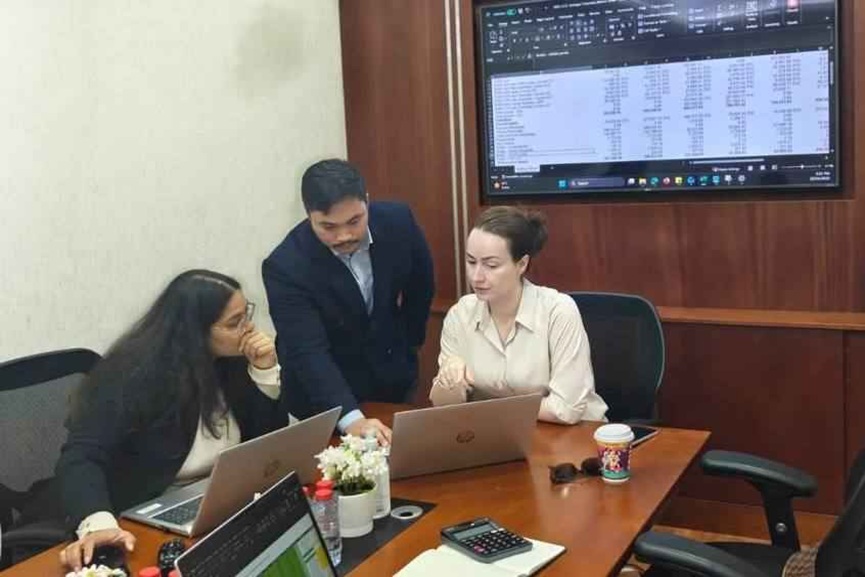
That becomes even more important in transaction-heavy businesses. In algorithmic trading, finance cannot sit back and wait for tidy summaries at month-end. Thousands of transactions may pass through multiple brokers and systems every day. If finance sees only the final output, it cannot test whether the picture is sound. Kaimova therefore helped define an internal transaction-accounting system able to aggregate broker data, track positions, and make reconciliation possible at scale.
Image supplied by Zezag Kaimova’s office | Cropped by Team GBN
There is also a cultural side to this work. In companies that grew without formal controls, people get used to shortcuts. Invoices get sent informally. Approvals happen in chats. Expenses are explained later. Fixing that is not only a systems job.
At one stage, this meant changing routines across a company of more than 200 people. Different teams had to be brought into the same process in different ways. Developers needed the logic explained through systems and data flows. Lawyers and managers needed it explained through risk, approvals, and accountability. The difficult part was not writing the process down. It was getting people to stop treating it as bureaucracy and start using it as part of everyday decision-making.
That is why Zezag Kaimova’s experience travels beyond trading. Gulf markets are becoming more transparent, more connected, and more demanding. In that environment, companies need more than a strong product or an aggressive growth plan. They need systems that can stand up to scrutiny. Financial infrastructure is no longer something built after success arrives. More often, it is what allows growth to hold together in the first place.