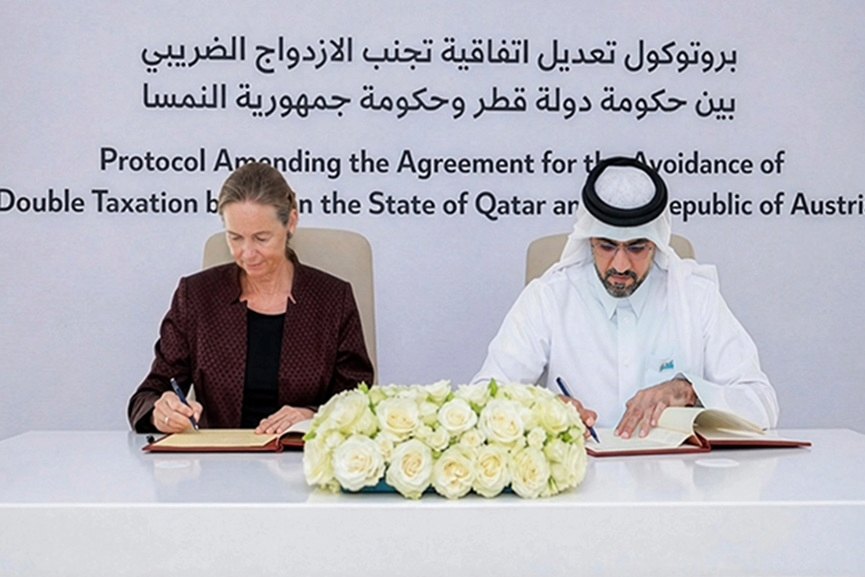
The State of Qatar and the Republic of Austria have signed a protocol amending key provisions of their bilateral agreement on the avoidance of double taxation and the prevention of fiscal evasion to enhance financial transparency.
The revised protocol was signed by Khalifa bin Jassim Al-Jaham Al Kuwari, President of the General Tax Authority of Qatar, and Erika Bernhard, Ambassador of Austria to Qatar.
Qatar’s General Tax Authority stated that the amendments are part of a broader effort to modernize the existing tax treaty in accordance with the latest global benchmarks.
The revisions enhance clarity, improve compliance mechanisms, and support the efficient exchange of financial information between the two nations.
The updated protocol introduces several substantive changes;
Article 8, which governs taxation related to international maritime and air transport, has been redrafted to better reflect current operational and regulatory realities in global logistics and aviation sectors.
Article 10, addressing dividend taxation, has been refined to more clearly define the eligibility criteria for government entities, reducing ambiguity and ensuring consistency in application.
A key feature of the revised agreement is the enhancement of Article 27, which pertains to the exchange of information for tax purposes.
The updated provisions bring the treaty in line with internationally recognized standards on transparency and administrative cooperation, enabling more robust data-sharing mechanisms to combat tax evasion and ensure accountability.
The authority emphasized that these changes reinforce Qatar’s commitment to maintaining a transparent and resilient tax system while also supporting international efforts to curb illicit financial flows.
The amended agreement is expected to serve as a catalyst for deeper economic engagement between Qatar and Austria. By reducing tax-related uncertainties and facilitating smoother cross-border financial operations, the agreement attracts a more favorable investment climate for businesses and institutional investors in both countries.
Officials noted that the strengthened framework will help expand trade flows and unlock new avenues for joint investment, particularly in sectors where both economies have complementary strengths.