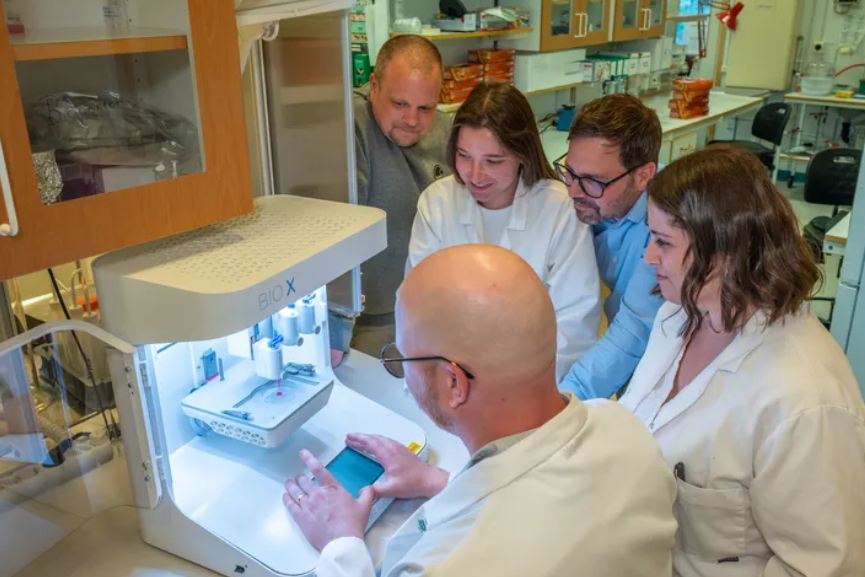
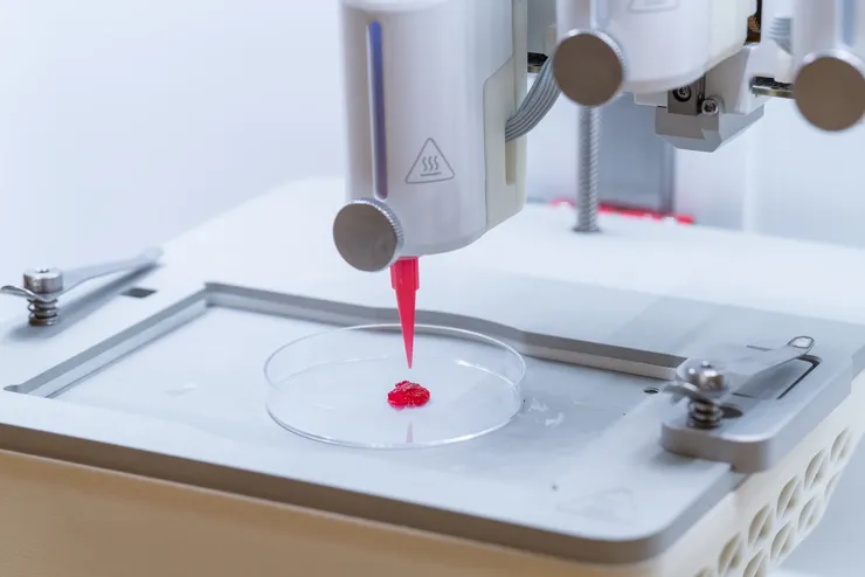
The Center for Disaster Medicine and Traumatology and Linköping University in Sweden has created a gel packed with live cells, nicknamed as “skin in a syringe”, that can be 3D printed into a skin transplant, as shown in a study conducted on mice.
Designed to help the body build functional dermis rather than scar tissue, the gel will help the body restore the skin barrier after a serious burn.
Large burns are often treated by transplanting a thin layer of the top part of the skin, the epidermis. This is basically composed of a single cell type. Transplanting only this part of the skin leads to severe scarring.
Image Credits: Magnus Johansson@Linköping University | Cropped by GBN
Under the epidermis there is a thicker and more advanced layer of skin called the dermis. It has blood vessels, nerves, hair follicles and other structures necessary for skin function and elasticity. However, transplanting also the dermis is rarely an option, as the procedure leaves a wound as large as the wound to be healed.
“The dermis is so complicated that we can’t grow it in a lab. We don’t even know what all its components are. That’s why we, and many others, think that we could possibly transplant the building blocks and then let the body make the dermis itself,” said Johan Junker, researcher at the Swedish Center for Disaster Medicine and Traumatology and docent in plastic surgery at Linköping University, who led the study published in Advanced Healthcare Materials.
The innovation combines fibroblast cells, the most common cell type in the dermis, also called the connective tissue cell, on gelatin beads with a hyaluronic acid gel, held together using click chemistry.
Image Credits: Magnus Johansson@Linköping University | Cropped by GBN
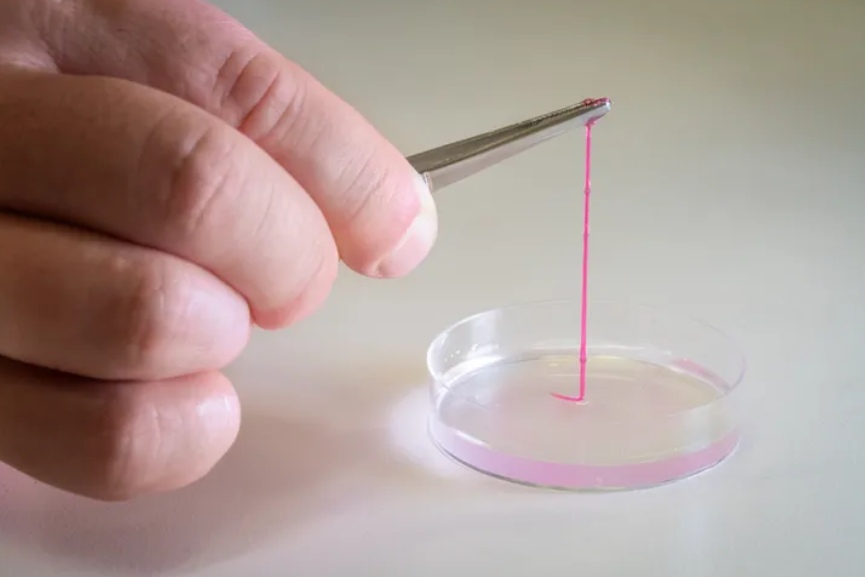
“The gel has a special feature that means that it becomes liquid when exposed to light pressure. You can use a syringe to apply it to a wound, for example, and once applied it becomes gel-like again. This also makes it possible to 3D print the gel with the cells in it,” highlighted Daniel Aili, professor of molecular physics at Linköping University, who led the study together with Johan Junker.
In a parallel advance, the team also created elastic hydrogel threads that can form tiny, fluid-carrying channels, paving the way for artificial tissues and organoid development.