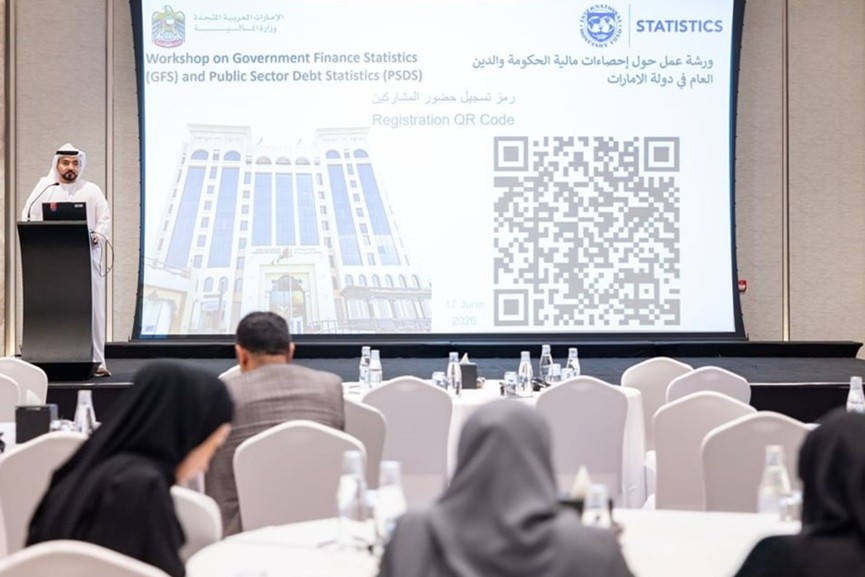
The UAE Ministry of Finance, in cooperation with the International Monetary Fund (IMF), hosted a specialized workshop in Dubai aimed at strengthening government finance statistics and public sector debt statistics in line with international standards.
The initiative focused on enhancing institutional and technical capabilities in compiling and publishing government financial data, while supporting the UAE’s efforts to improve data quality, fiscal transparency and integration across macroeconomic statistics.
UAE-IMF workshop boosts fiscal transparency
Saeed Rashid Al Yateem, Assistant Under-Secretary for the Government Budget and Revenue Sector at the Ministry of Finance, said the workshop reflects the ministry’s commitment to strengthening government financial data systems and improving the accuracy of data used in fiscal planning and policymaking.
Al Yateem said Government Finance Statistics and Public Sector Debt Statistics are essential for enhancing fiscal transparency, improving reporting efficiency and providing a clearer picture of public sector financial performance. He added that continued investment in these areas supports fiscal sustainability and strengthens the UAE’s ability to respond to changing economic conditions.
He noted that cooperation with the IMF supports the adoption of international best practices in financial data compilation and dissemination, while also improving coordination and consistency across macroeconomic datasets.
Focus on international standards
The workshop included detailed sessions on the Government Finance Statistics Manual 2014 (GFSM 2014), covering analytical frameworks, institutional coverage and government financial reporting concepts.
Participants also reviewed key aspects of Public Sector Debt Statistics, including debt instruments, sector classifications, valuation principles and debt reporting frameworks.
Discussions further addressed international data dissemination standards and fiscal transparency requirements, including the Enhanced General Data Dissemination System (e-GDDS) and the Special Data Dissemination Standard (SDDS), in addition to metadata requirements and reporting practices.
Enhancing macroeconomic data integration
The sessions also highlighted the importance of consistency across macroeconomic indicators, including government finance statistics, public debt statistics, national accounts, balance of payments data and monetary statistics, to support an integrated economic data system.
The workshop featured practical discussions on the findings and recommendations of the IMF technical mission, focusing on data gaps, reconciliation challenges and proposed technical measures to improve financial data compilation and reporting.
The initiative in collaboration with IMF forms part of the UAE Ministry of Finance’s broader efforts to align government financial reporting with international standards, strengthen coordination among relevant entities and enhance the use of financial data in economic analysis and evidence-based policymaking.