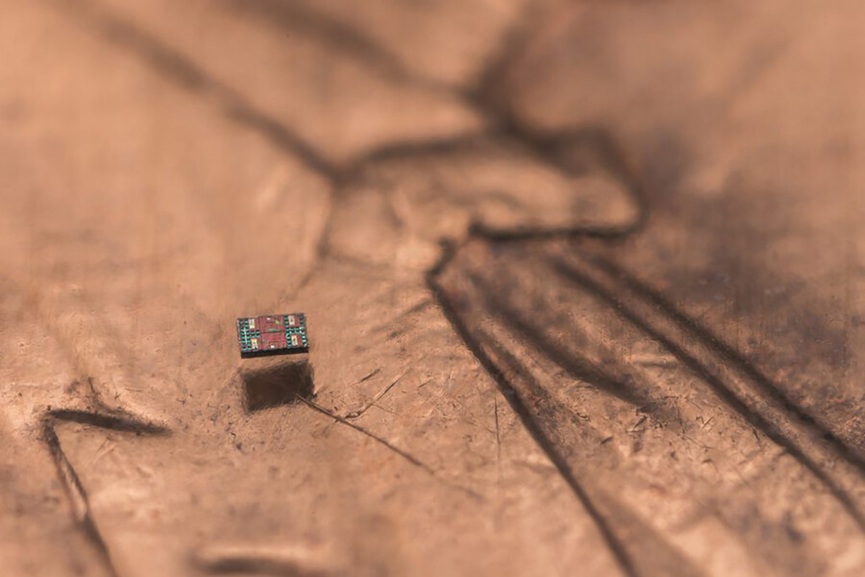
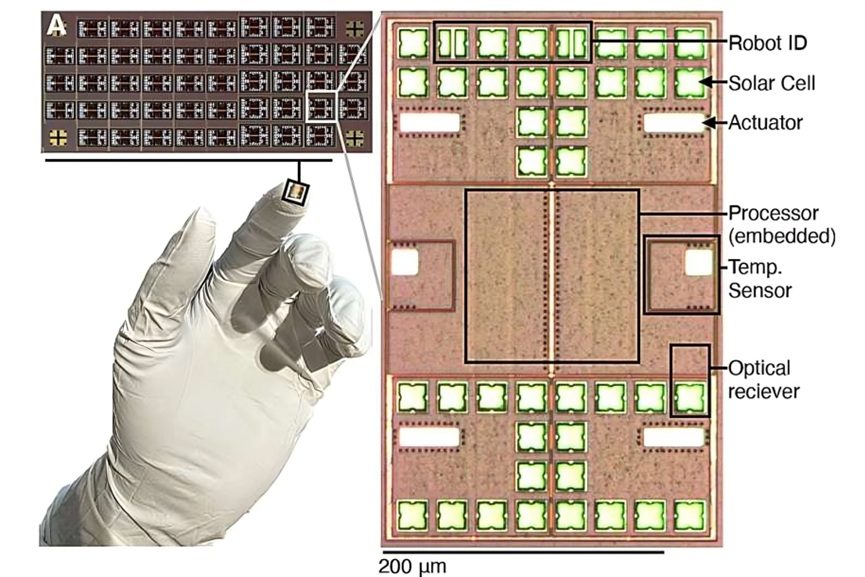
Researchers from the University of Pennsylvania and University of Michigan has unveiled the world’s smallest fully programmable, autonomous robots, measuring just 200 by 300 by 50 micrometers, smaller than a grain of salt.
The microscopic swimming machines in autonomous robots sense their surroundings, respond independently, operate for months, and cost only a penny each. Published in Science Robotics and Proceedings of the National Academy of Sciences, the breakthrough shatters the sub-millimeter barrier in robotics after decades of stagnation.
The breakthrough was achieved by merging two recent innovations: a microscopic computer from the University of Michigan and a custom-designed propulsion system from the University of Pennsylvania.
These autonomous robots operate without tethers, magnetic fields, or external controls, marking the first truly autonomous devices at this scale. Powered by LED light via tiny solar panels producing just 75 nanowatts, they integrate microscopic computers, sensors, and propulsion systems.
The innovation of world’s smallest autonomous robots enable complex movements, temperature detection to within one-third of a degree Celsius, and coordinated group behaviors resembling a school of fish, reaching speeds of one body length per second.
At microscale, traditional robot designs fail majorly due to dominant surface forces like drag and viscosity, which mimic tar-like resistance in water. Gravity and inertia, key at human scales, become negligible. The team overcame this with a novel propulsion method: electrodes generate an electrical field that nudges ions in surrounding fluid, indirectly animating water molecules around the robot’s body. This creates a self-induced ‘moving river’ effect, allowing durable, flex-free swimming without fragile limbs or arms.
Electronics posed another hurdle. David Blaauw’s University of Michigan team, holding the record for the smallest computer, developed ultra-low-power circuits operating at minimal voltages, over 1,000 times more efficient than conventional designs. Custom instructions condensed propulsion controls into single commands, fitting processors, memory, and sensors into the limited space beside solar panels. Light pulses program each robot via unique addresses, enabling individualized tasks in swarms.
Autonomous robots that think, sense, react
The new autonomous robots sense temperature gradients to track cellular activity, move toward heat sources, or perform ‘waggle dances’ to communicate data, decoded via microscope like bee signals. Such capabilities position them for medical applications, like monitoring individual cell health, and manufacturing microscale devices. The durability of these autonomous robots allows repeated transfers via micropipette without damage, supporting long-term deployment.
Image credits: Miskin Lab, Penn Engineering; Blaauw Lab, University of Michigan| Cropped by GBN
The achievement stems from a five-year collaboration sparked at a DARPA event, combining Penn’s propulsion expertise with Michigan’s microelectronics. Previously, robotics lagged electronics miniaturization; no prior sub-millimeter device featured a full processor, memory, and sensors for true autonomy. This platform scales cheaply, paving the way for enhancements like faster speeds, advanced sensors, or harsh-environment operation.
Future iterations in robotics could layer intelligence for diverse roles, from drug delivery in bloodstreams to precision assembly in biotech. The design’s modularity supports GCC innovation ecosystems, aligning with regional pushes in advanced manufacturing and health tech under Saudi Vision 2030 and UAE’s post-oil diversification. As mineral-rich nations invest in tech sovereignty, such micro-robots could bolster local R&D in nanotechnology and biomedicine.
Image credits: Lucas Hanson and William Reinhardt, University of Pennsylvania| Cropped by GBN
Global implications of these autonomous robots extend to environmental monitoring and space exploration, where swarms navigate confined spaces. Fabricated at scale, their penny-cost democratizes access, potentially transforming industries reliant on precision at cellular levels. Researchers view this as the foundation for a new robotics era, where microscale autonomy rivals larger machines in versatility.
The researchers are optimistic that, with continued advancements in technology, they will be able to significantly increase the onboard memory of their rudimentary robots, enabling more complex programming and paving the way for increasingly sophisticated autonomous behaviors in future generations of microscopic robots.