Researchers have developed a new plastic upcycling technique that transforms commonly used plastics into materials that degrade more quickly, offering a potential breakthrough in the fight against global plastic pollution.
The new process, created by scientists from the University of Edinburgh and RPTU University Kaiserslautern-Landau, converts existing plastics into a biodegradable material known as polythionoester. The findings were published in the journal Chem Circularity.
Researchers say the discovery is significant because nearly 99 percent currently in use are not biodegradable. Existing environmentally friendly alternatives often degrade slowly or require extreme heat and harsh chemicals to break down effectively.
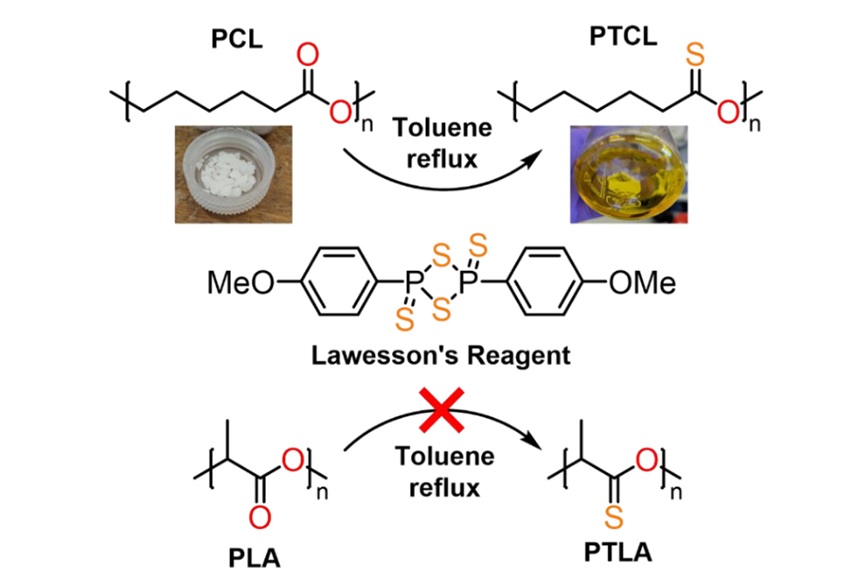
The newly developed method modifies the chemical structure of existing plastics by replacing some oxygen atoms bonded to carbon with sulfur atoms. Scientists used a molecule called a thionating agent to carry out the transformation through a simple one-step process.
According to the research team, the resulting polythionoester material contains carbon-sulfur bonds that are weaker than the carbon-oxygen bonds found in conventional plastics. This gives the material different physical properties while making it significantly easier to degrade.
The scientists tested the process on polycaprolactone, a biodegradable plastic commonly used in food packaging, 3D printing and biomedical implants. The team reported that the method proved effective and could potentially be expanded to its other forms.
Image Credits: Chem Circularity | Cropped by GBN
Researchers also highlighted the scalability of the process, noting that large quantities could be converted rapidly using the straightforward technique. They added that the method’s adaptability may open up broader applications in plastic recycling and sustainable material development.
Potential for future sustainable materials
Dr. Jennifer Garden, who co-led the study at the University of Edinburgh’s School of Chemistry, described the achievement as a major step forward in polymer science. She explained that converting polyesters into sulfur-containing materials has traditionally been difficult because these materials are less reactive during the thionation process.
She noted that the newly developed strategy creates opportunities to produce an entirely new class of sulfur-containing materials with improved degradability. Garden also said the research team is eager to explore further applications of the breakthrough and continue studying its potential across multiple fields.
The researchers cautioned that additional studies are still needed to better understand the environmental impact of the breakdown products produced when polythionoesters degrade.